
The Complexity No One Warns You About Once Omnichannel Hits Scale
Blogs
Key Highlights
- Adding channels is no longer the hard part. 86% of organizations already manage three or more sales channels per country, and 38% manage five or more.
- Channels rarely run alone. Close to a third run a brand website, marketplace and physical store together, each with its own listings, pricing and stock to keep in step.
- Fulfillment has become the bottleneck. Almost half of respondents fulfill orders from five or more locations per country, which multiplies the decisions behind every order.
- Integration, not reach, is the top barrier to scale. When asked about scaling across marketplaces or social commerce, commerce leaders named integrating systems and data as their biggest challenge.
At some point, every growing retailer hits the same wall: the more channels you add, the less you see the whole picture. The idea of going omnichannel always sounded simple. Sell where your customers are. That definition is now too narrow. As our report puts it, multichannel means adding channels, while omnichannel means coordinating them. What’s often missed is the operational strain of scaling omnichannel operations once you add more channels and your business grows.
Every new channel brings its own systems or platforms, partners, and requirements, and usually, none of them work with what you already have. So, reach was never the hard part. Coordinating everything behind it is. Anchanto and Demand Metric’s recent report, The State of Omnichannel Commerce 2026/27, a survey of 408 commerce decision-makers at companies with annual revenue above US$ 100 million, shows exactly how far this disconnected reality has gone.
1. Every Channel is Running Its Own Operation
Our research found that 86% of organisations manage three or more sales channels per country, and 38% manage five or more. Most organisations pair a brand website with online marketplaces (46%), and close to a third (31%) run a website, marketplace, and physical store together. Those managing more channels may also have social commerce platforms, a B2B channel, and a mobile app.
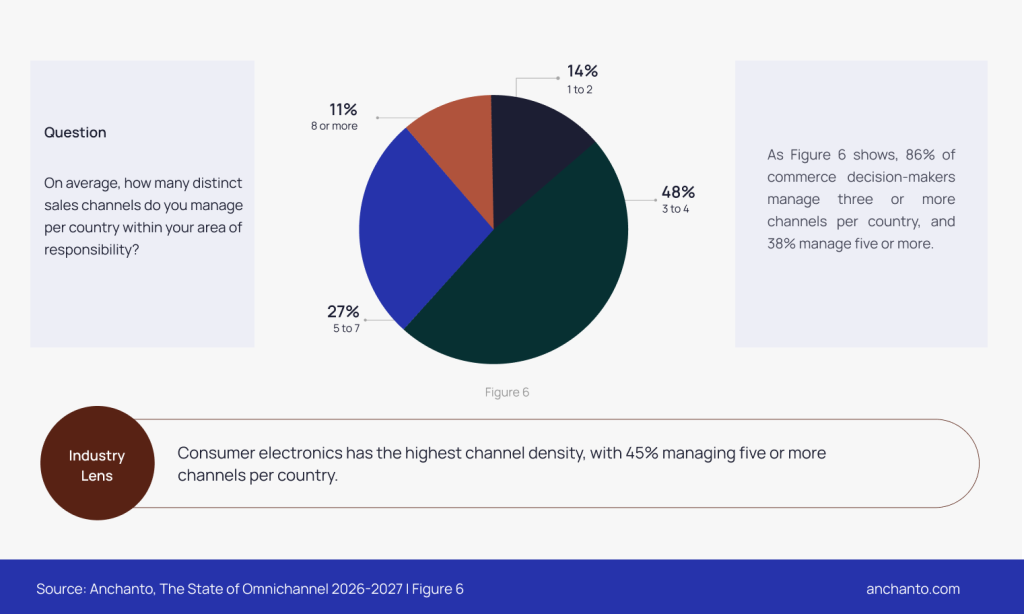
Figure 6: Number of sales channels managed per country. 86% of commerce decision-makers manage three or more sales channels per country, and 38% manage five or more: 14% manage one to two, 48% three to four, 27% five to seven, and 11% eight or more. Consumer electronics has the highest density, with 45% managing five or more. Source: Anchanto and Demand Metric, The State of Omnichannel Commerce 2026/27, survey of 408 commerce decision-makers.
Each channel has its own requirements, and running them together creates shared dependencies. Every channel has its own product listings, inventory, pricing rules, promotions, and customer expectations, and all of it has to stay accurate at the same time. That is the real challenge with omnichannel today. Not how many channels you add, but how well you coordinate the ones you already support.
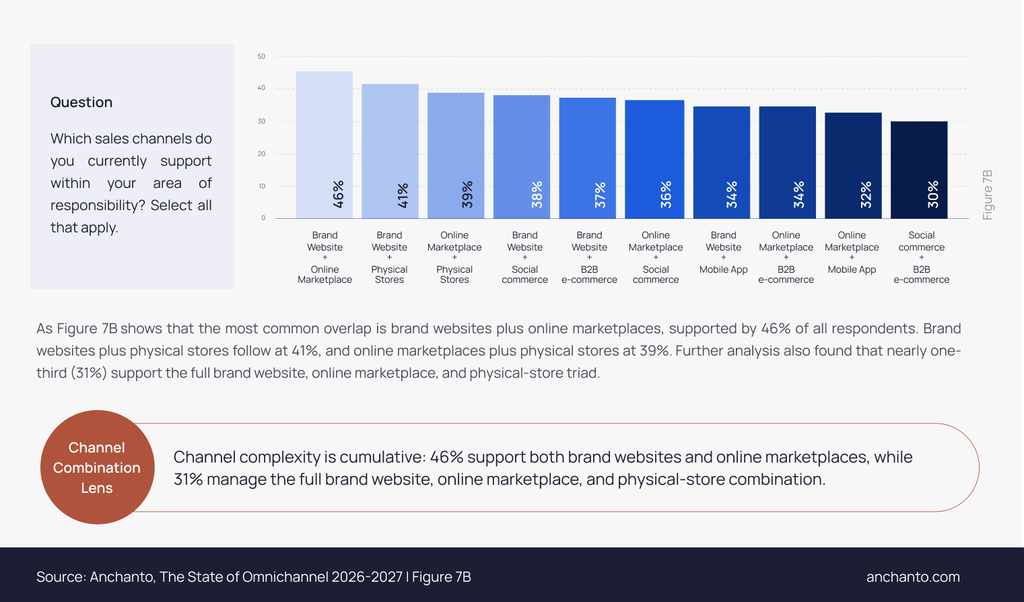
Figure 7B: The most common sales channel combinations. The most common channel combination is a brand website plus online marketplaces (46%), followed by brand website plus physical stores (41%) and online marketplaces plus physical stores (39%). 31% support the full brand website, online marketplace and physical store triad. Source: Anchanto and Demand Metric, The State of Omnichannel Commerce 2026/27, survey of 408 commerce decision-makers.
2. Coordinating Omnichannel Fulfilment is a Major Bottleneck
Every channel added needs somewhere to ship from. As channel counts climb, fulfilment networks stretch to keep pace, often faster than anyone planned for. Almost half (46%) of the respondents surveyed in our research said they fulfil orders from five or more locations per country, and 91% fulfil from two or more.
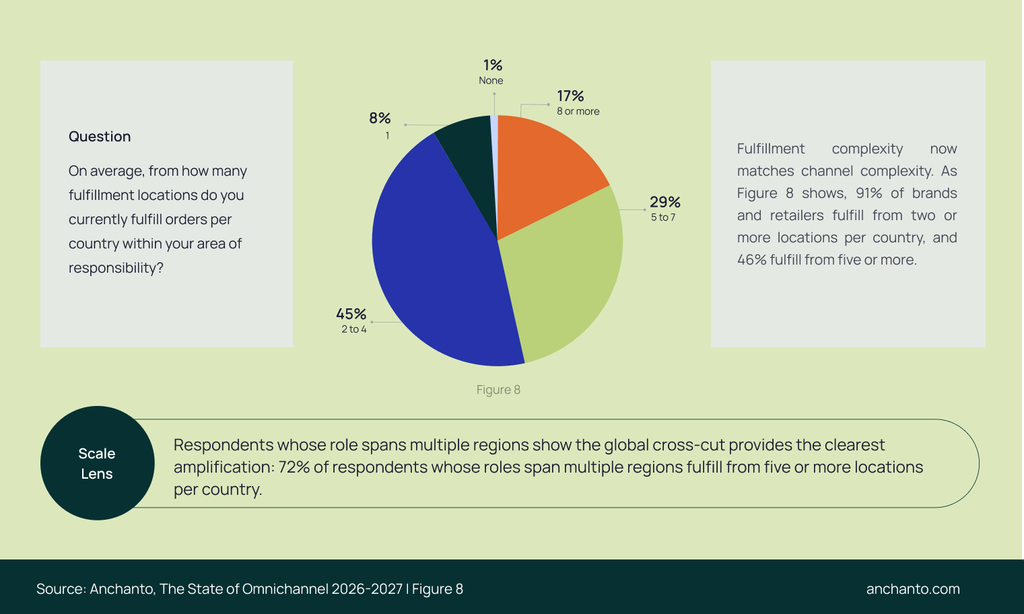
Figure 8: Number of fulfilment locations per country. 91% of brands and retailers fulfil orders from two or more locations per country and 46% from five or more: 1% from none, 8% from one, 45% from two to four, 29% from five to seven and 17% from eight or more. Among respondents whose role spans multiple regions, 72% fulfil from five or more. Source: Anchanto and Demand Metric, The State of Omnichannel Commerce 2026/27, survey of 408 commerce decision-makers.
Picture what that means for a single order. A brand could ship a product from a store, a regional warehouse, or a third-party partner, and someone on the team has to work out which fulfilment centre has the available stock, is closest to the customer, and can actually get it there on time. This process is usually done manually because none of the fulfilment locations share real-time visibility of their inventory, and there is no automation to allot an order to the right centre for fulfilment.
Now multiply this operation by every order placed in a day, across every channel, and the bottleneck comes into focus. Fulfilment slows down because the same decisions are repeated manually for every order.
4. The Missing Link for Smooth Omnichannel
We asked commerce leaders what their biggest challenge is when scaling across marketplaces or social commerce. The top answer, at 27%, was integrating systems and data, ahead of meeting marketplace requirements (19%) and managing promotions and pricing (17%). This is the case even though most of the businesses we surveyed perform omnichannel operations across multiple sales and fulfilment channels.
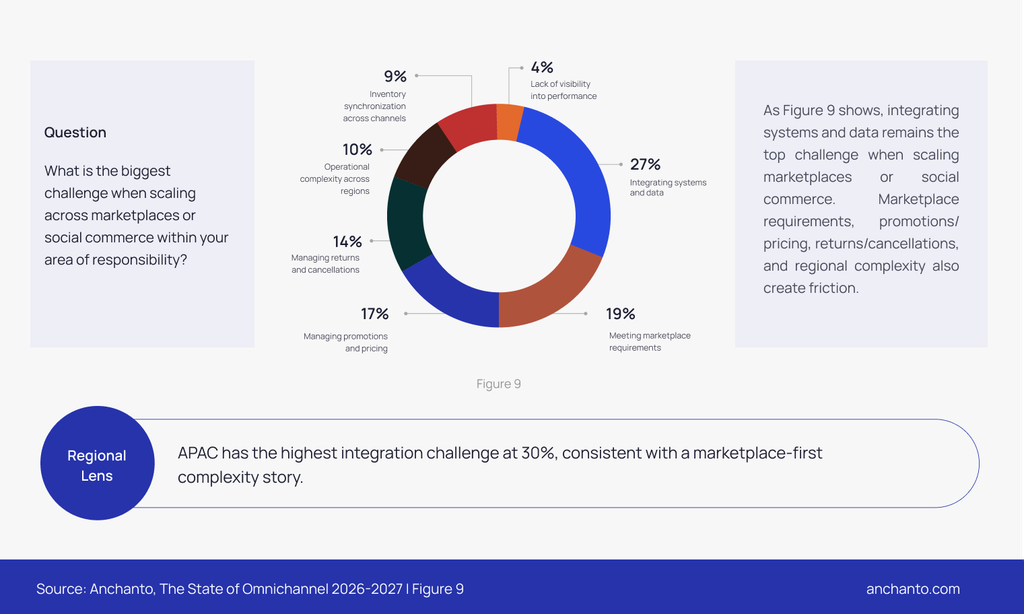
Figure 9: The biggest challenge when scaling across marketplaces or social commerce. Integrating systems and data is the biggest challenge when scaling across marketplaces or social commerce (27%), followed by meeting marketplace requirements (19%), managing promotions and pricing (17%), managing returns and cancellations (14%), operational complexity across regions (10%), inventory synchronisation across channels (9%) and lack of visibility into performance (4%). APAC is highest on integration at 30%. Source: Anchanto and Demand Metric, The State of Omnichannel Commerce 2026/27, survey of 408 commerce decision-makers.
So, when a catalogue management system does not connect with sales channels, a marketplace doesn’t integrate with an inventory management system, or an order management system doesn’t update a warehouse management system, gaps are created. These gaps require manual intervention where teams of people check, reconcile, upload or update information by hand. Every new channel or warehouse just adds to the effort required.
This is the part of omnichannel nobody puts in the pitch deck. Not the number of channels you can sell through, but the number of systems that have to communicate with each other for efficient omnichannel.
5. Where this Leaves Your Organisation
Channel growth and fulfilment growth expose the same problem, in two different places. Our report on The State of Omnichannel Commerce 2026/27 further breaks down where omnichannel strain shows up the most, by industry, region, and seniority. That way, you can close the gap and turn channel growth into a competitive advantage.
Download the full report here!FAQs
1. What makes scaling omnichannel operations so difficult?
Each new channel brings its own listings, inventory, pricing rules and promotions, and all of it has to stay accurate at the same time. 86% of organisations run three or more sales channels per country, and integrating systems and data (27%) is the top challenge when scaling across marketplaces or social commerce.
2. How many sales channels do enterprise brands and retailers manage?
86% manage three or more sales channels per country and 38% manage five or more. The most common combination is a brand website and online marketplaces (46%), and 31% run a brand website, marketplace and physical store together.
3. Why is an omnichannel fulfilment strategy hard to run at scale?
Fulfilment networks have grown as fast as channel counts: 46% of brands and retailers fulfil from five or more locations per country. Without shared, real-time inventory visibility and automated order allocation, teams manually decide which location should ship each order, and the same decision repeats for every order.
4. How do firms keep omnichannel brand execution consistent at scale?
Keeping stock, pricing and product information correct everywhere in real time is the key to consistent omnichannel execution. But this depends heavily on how the systems behind each channel exchange data. When platform (marketplaces, webstores, physical stores) and systems (catalogue, order and warehouse management systems) are disconnected, teams fill the gaps by hand and consistency slips with every channel or fulfilment location added.
About the data.
The State of Omnichannel Commerce 2026/27 is based on a global survey of 408 qualified commerce decision-makers (395 complete and 13 partial responses) at organisations with annual revenue above US$ 100 million, run by Anchanto with Demand Metric. Respondents are directly involved in commerce strategy, technology or operations, and are split across the Americas (27%), Europe (27%), APAC (25%) and the Middle East and Africa (21%).