
Why Your Best Performing Promotion Might Be Losing You Money
Blogs
Key Highlights
- Not all enterprises in commerce can optimise promotions across channels using unified data and near-real-time insight.
- 33% can measure across most channels, 29% measure by channel but struggle to connect the results, and 21% see sales impact but have limited visibility into margin or returns.
- Optimising promotions and pricing is the most valued AI and data use case, chosen by 46% of enterprises.
A promotion can go live in minutes. But determining whether it actually worked can take weeks. Often in organisations, the team has already moved on to the next promotion by the time their retail promotion analytics produce a real answer.
Why does it take so long to know if your promotion was a success? It’s because “Did the promotion work?” is a four-part question. The four aspects that need to be answered are:
- Did the promotion boost sales across every channel it ran on?
- Did it protect margin, or quietly erode it through a discount that cost more than it earned back?
- Did it move the right inventory, or cause a shortage at a location?
- Did it create a repeat customer, or just a one-time deal chaser who will not come back at full price?
Most organisations can’t see all four at once as 88% can’t yet optimise promotions across channels with unified, near-real-time data. Whatever they can’t see is still a guess, no matter how good the results look on paper.
1. The Question Almost Nobody Can Fully Answer
We asked 408 commerce decision-makers from Europe, MEA, the Americas, and APAC how well they can plan, measure, and optimise promotions across channels. Only 12% said they can optimise promotions across channels using unified data and near-real-time insight, according to The State of Omnichannel Commerce 2026/27 report by Anchanto and Demand Metric. In other words, they can see how a promotion performs across channels while it is still running.
As for the rest of the enterprises surveyed, most fall short of this visibility. A third (33%) can measure performance across most channels and adjust future campaigns. Some (29%) can measure performance by channel but struggle to connect the results. Others (21%) can see the sales number clearly but have limited visibility into what the promotion actually did to margin or returns, and 5% cannot consistently measure promotion performance across channels. Each blind spot leaves at least one of the four questions above unanswered. A team that can see sales but not margin knows the promotion moved product but has little visibility into whether it made or lost money doing it.
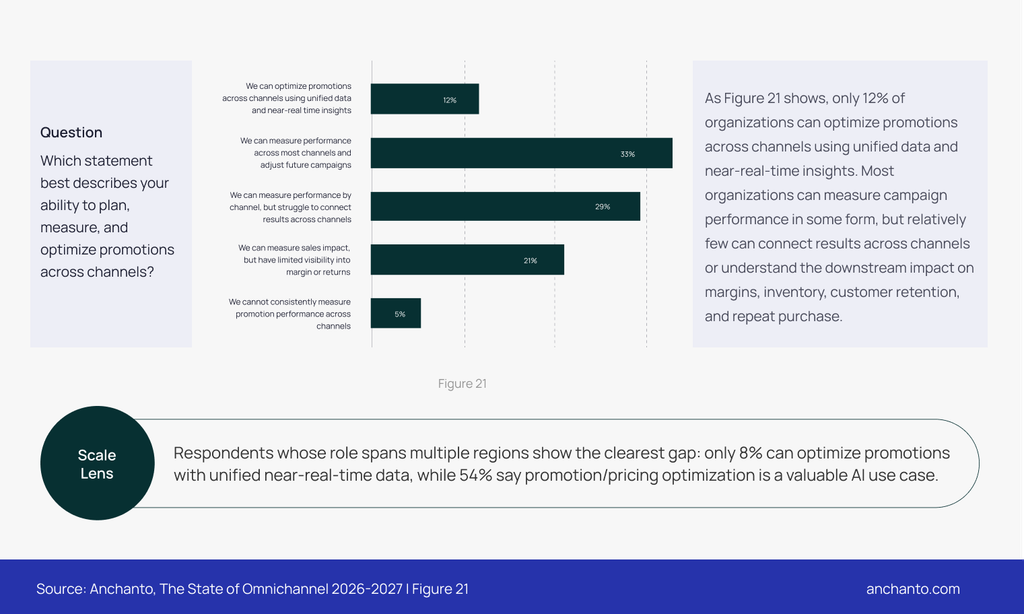
Figure 21: Ability to plan, measure and optimise promotions across channels. Only 12% of organisations can optimise promotions across channels using unified data and near-real-time insight. 33% can measure performance across most channels and adjust future campaigns, 29% measure by channel but struggle to connect results, 21% see sales impact but have limited visibility into margin or returns and 5% cannot consistently measure promotion performance. Source: Anchanto, The State of Omnichannel Commerce 2026/27, survey of 408 commerce decision-makers.
2. A Promotion Touches More Than Sales
Not being able to see margin, inventory, or retention next to sales is expensive. Picture a promotion built and stocked for one specific region. It goes live, lifts weekly revenue there by 20%, and the sales dashboard calls it a clean win. This is the only number the team sees in real time. What that number doesn’t show is how much profit per unit actually fell, because the discount needed to drive that lift was steeper than planned.
An added challenge is stockouts. Once demand shows up, stock can run out quickly, and a wave of delayed orders follows. Disconnected systems make this worse: 39% of respondents say they cause delayed order processing, and 36% say they lead to inventory inaccuracies or overselling. Businesses running an omnichannel model can utilise inventory assigned to other channels to fulfil promotion orders. However, without real-time inventory visibility it’s difficult to identify the best source.
On retention, most enterprises have limited visibility into how many of their “new” customers are one-time deal seekers who will not buy again at full price. At the moment of purchase, a genuine new customer and a serial discount shopper look identical in the data, both are just a completed order. The difference only shows up weeks or months later, when the discount shopper never returns and the genuine customer does. Most teams are not set up to trace that first promotional order forward and find out which one actually happened, so a promotion can look like it built new customers when it really just paid people to buy once.
A promotion is not a single event confined to a price tag. It is a decision that impacts pricing, inventory allocation, fulfilment capacity, and customer behaviour all at once.
3. Many Want AI for Promotions. Almost No One has the Data for It
When the same 408 decision-makers were asked to pick which AI and data capabilities would create the most value for their business, optimising promotions and pricing was the most frequently chosen answer. 46% selected it as one of their top three picks.
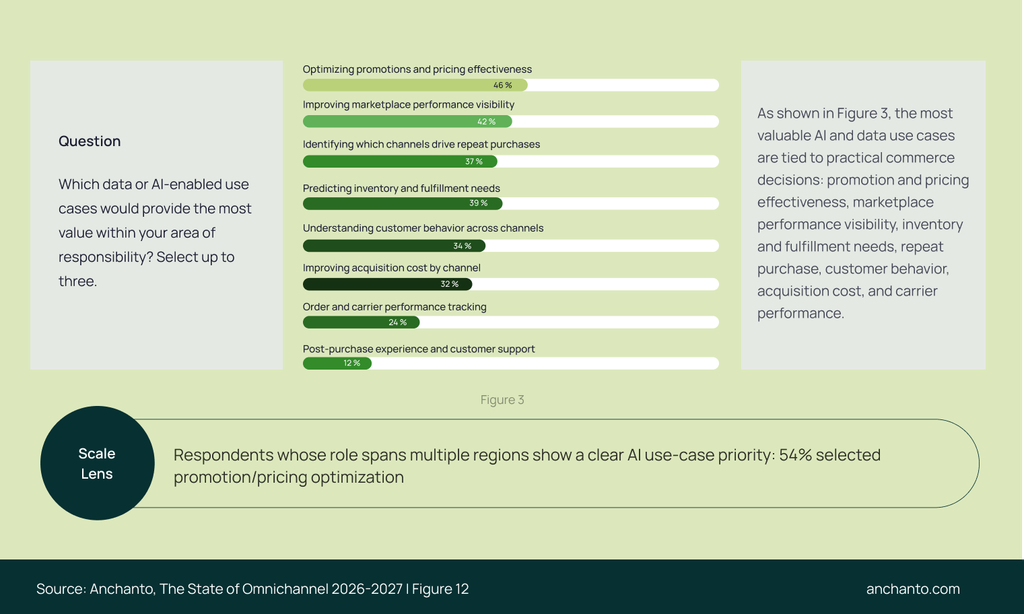
Figure 3: The data and AI use cases that would add the most value. Optimising promotions and pricing effectiveness is the most valued AI and data use case (46%), ahead of marketplace performance visibility (42%), predicting inventory and fulfilment needs (39%), identifying channels that drive repeat purchase (37%), understanding customer behaviour across channels (34%), acquisition cost by channel (32%), order and carrier performance tracking (24%) and post-purchase experience (12%). Respondents could select up to three. Source: Anchanto, The State of Omnichannel Commerce 2026/27, survey of 408 commerce decision-makers.
Set that next to the 12% who can optimise promotions across channels today. Nearly half of commerce leaders see promotions as one of the most valuable places for AI to work, but only a small fraction have the connected, real-time data it depends on. The appetite is well ahead of the operating model needed to satisfy it.
The challenge is not a lack of data. It is data sitting in disconnected pieces instead of one unified view. In practice, the missing pieces usually come down to a few specific things:
- Cross-channel sales data. Many teams can see sales per channel (web, marketplace, app, store) but struggle to combine them into one live view of how a single promotion performed everywhere it ran. 29% measure promotion performance by channel but can’t connect the results.
- Real-time inventory tied to pricing decisions. Only 6% of organisations have end-to-end visibility across orders, inventory and fulfilment, and 41% have good visibility across key workflows that aren’t fully unified. Without that, a promotion can launch without anyone knowing it’s about to run into a shortage.
- Margin and cost data are connected to the promotion itself, not just revenue. 21% can see a promotion’s sales impact but have limited visibility into margin or returns. Sales dashboards often stop at units and revenue, leaving out landed cost, discount depth and true margin per unit.
- Customer-level purchase history, to tell a genuinely new or returning customer apart from a one-time deal seeker who only shows up during a discount.
Once that data is actually connected, AI promotion optimisation has a specific job to do with it. For example, AI can help in forecasting demand at the SKU and location level, instead of applying one blanket assumption per market. AI can also check real-time inventory so a discount does not run against stock that is already thin. It can help adjust discount depth by product or market instead of using one flat percentage everywhere. It can even target price-sensitive one-time buyers separately from likely repeat customers.
4. Success is Still a Guess for Most Organisations
Go back to that 20% revenue lift. If sales, margin, inventory, and retention had all been visible together in real time, someone could have caught stock running thin before it turned into a stockout, seen the margin erosion while there was still time to pull back the discount, and known within days, not months, whether those “new” customers were actually coming back. Instead, the team saw one clean number and called it a win.
That is the real cost of a disconnected view. Not that the promotion failed, but that no one can say with certainty whether it actually succeeded. And the next promotion, and the one after that, will repeat the same guess.
Our report, The State of Omnichannel Commerce 2026/27, shows the gap is sharpest for leaders whose roles span multiple regions: only 8% can optimise promotions with unified, near-real-time data, yet 54% see promotion and pricing optimisation as a valuable AI use case. It also includes a 10-step Omnichannel Execution Maturity Model for building the connected data businesses need.
Download the full report here!FAQs
1. How do you know if a promotion actually worked?
For an accurate result, answer these four questions together: did it lift sales on every channel, protect margin, move the right inventory and create repeat customers? Most organisations can’t see the answer to all four questions at once. Only 12% of organisations can optimise promotions across channels using unified data and near-real-time insight.
2. What should retail promotion analytics measure?
Cross-channel sales, real-time inventory at location and channel level, true margin per unit after discount depth and landed cost, and customer-level purchase history that separates genuine new customers from one-time deal seekers. Without these in one view, a promotion’s success is still a guess.
3. What is cross-channel promotion optimisation?
Planning, measuring, and adjusting a promotion from one live view of how it performs on every channel at once, rather than channel by channel. Only 12% of organisations can do this today, while 29% can measure by channel but struggle to connect the results across channels.
4. How does AI improve price and promotion optimisation?
Once the data is connected, AI can support the decisions commerce leaders value most: promotion and pricing effectiveness, inventory and fulfilment prediction, and identifying which channels drive repeat purchase. Promotion and pricing optimisation is the most-selected AI use case in the report, chosen by 46% of commerce leaders.
About the data.
The State of Omnichannel Commerce 2026/27 is based on a global survey of 408 qualified commerce decision-makers (395 complete and 13 partial responses) at organisations with annual revenue above US$ 100 million, run by Anchanto with Demand Metric. Respondents are directly involved in commerce strategy, technology or operations, and are split across the Americas (27%), Europe (27%), APAC (25%) and the Middle East and Africa (21%).
Download the full report here!