Key Highlights:
-
- A service level agreement (SLA) turns a performance target into a commitment both sides can check. A key performance indicator (KPI) shows how operations are performing, and the SLA sets the level it needs to reach.
-
- Clear terms give brands and 3PLs the same basis for judging performance. When the SLA specifies what is measured and how, there is less to interpret when something goes wrong.
-
- The most useful metrics cover the whole order journey, from picking to returns. Each one should match the party that manages it, since dispatch and accuracy sit mainly with the provider while delivery also depends on carriers.
-
- In third-party logistics (3PL) partnerships, results depend on both sides. The provider delivers its commitments, and the brand’s inputs and peak-period planning shape how well they can be met.
-
- Reviewing results once the period closes shows a miss when it is too late to prevent it. Tracking orders through the day, with alerts and named owners, gives teams a chance to step in sooner.
Picture this: a parcel is delivered two days late. At the warehouse, it was dispatched on time. But the carrier says it was collected late, leaving the brand with an unhappy customer and no clear answer. A service level agreement in logistics prevents that standoff by setting measurable commitments, and agreed ways of measuring them, before anything goes wrong.
Brands and 3PLs that agree upfront on how each target is measured can trace a missed delivery to its cause quickly and agree on the fix. This article explains how to set SLA targets so both sides can check and how to catch misses before customers notice them.
What is a Service Level Agreement (SLA)?
A service level agreement is a formal, documented contract between a service provider and a client, often attached to the main contract. It sets measurable targets for services such as order fulfilment and delivery, giving both parties a basis for monitoring performance and addressing service failures. In logistics, it turns the commercial relationship between a shipper and their logistics partner into auditable performance standards.
An SLA may form part of a broader master services agreement (MSA). The MSA usually establishes the overall commercial relationship, while the SLA specifies the service standards and measurement methods agreed between the parties. These commitments may also be incorporated directly into the main contract.
SLA vs. KPI: Understanding the Difference
A KPI measures performance, and an SLA sets the threshold that KPI must meet.
| KPI | SLA | |
| What it is | A performance measurement | A contractual performance obligation |
| Who sets it | Internal team or provider | Agreed between client and provider |
| Example | On-time dispatch rate | An agreed minimum on-time dispatch rate |
| Primary purpose | Track and improve operations | Enforce accountability and set expectations |
| Visibility | Internal reporting | Shared between client and provider |
In practice, teams can treat KPIs as an early-warning system for SLAs. Monitoring KPIs throughout fulfilment shows which orders are at risk of missing their SLA targets while there is still time to act.
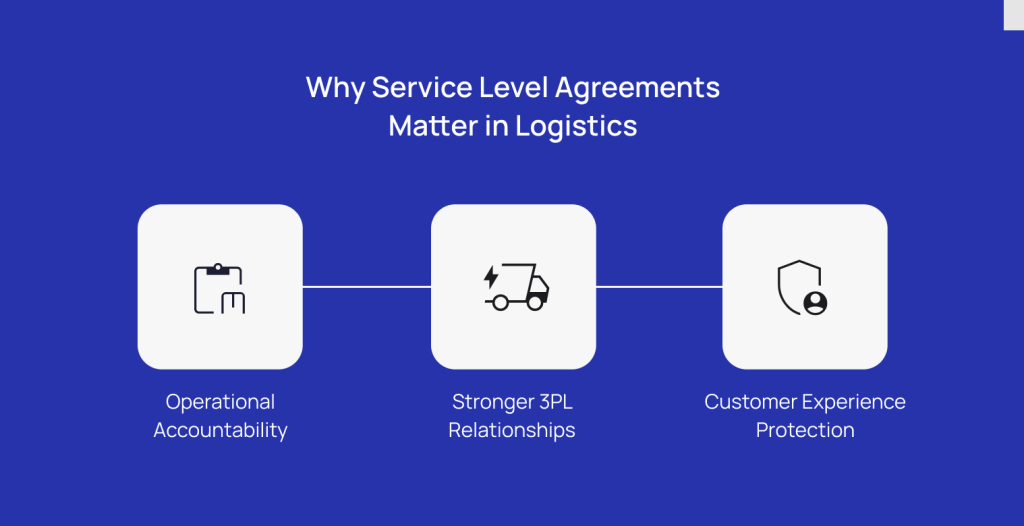
Why Service Level Agreements Matter in Logistics
Logistics operations pass orders between warehouses, carriers, customs, and last-mile partners. SLAs set out which party is responsible for each commitment and the standard it is held to. This gives teams a clear basis for assessing where a failure occurred and what to do about it.
a. Operational accountability
When an order arrives late, the SLA gives both sides (brands and 3PLs) a way to find out why. Each commitment has its own target, so teams can check them in sequence. If the warehouse dispatch time falls inside the agreed window but the carrier collected the parcel hours later, the delay sits with the carrier. The SLA’s measurement rules and exclusions then settle whether that miss counts against the provider.
b. Stronger 3PL relationships
An SLA protects both sides of a 3PL partnership. The brand knows exactly what service it is paying for. The 3PL knows what it will be held to, and which delays fall outside its control, such as late inbound stock or orders above the agreed forecast. Peak planning and contract renewals then start from terms both sides have already accepted.
c. Customer experience protection
Two problems a customer notices start in the warehouse: the wrong item in the box, and an order that leaves too late to arrive on time. An SLA can set targets for both, such as 99.5% of orders packed correctly and 98% dispatched before the daily cut-off.
Types of Logistics SLAs
Logistics providers can use different SLA structures to define service commitments across their operations. These agreements establish which performance standards apply to a particular relationship and how those commitments are documented. Three primary types of logistics SLAs are broken down below.
a. Customer-based SLA
A customer-based SLA is one agreement that covers every service a provider delivers to a single client. A 3PL handling a skincare brand, for example, might commit to same-day dispatch, batch and expiry tracking, and returns inspected within 48 hours, all in the same document. Each brand the 3PL serves gets its own agreement, so the terms can reflect that brand’s products and sales channels.
b. Service-based SLA
A service-based SLA sets one standard for a service, and every client using that service gets the same terms. A carrier’s express product is a typical case: every shipper buying it gets the same next-day delivery commitment, whatever their size or sector. This suits providers selling standardised services, since they don’t negotiate terms client by client.
c. Multilevel SLA
A multilevel SLA combines a shared baseline that applies to every client with extra terms for individual clients. A 3PL might commit to receiving all inbound stock within 24 hours and keeping inventory records 99% accurate for every brand it serves, while one brand’s agreement adds a 2pm dispatch cut-off. The provider sets the basics once and negotiates only the differences.
Key Components of a Service Level Agreement
A logistics SLA is easier to assess when its targets are specific about what is being measured. A target such as “dispatch within 24 hours” can specify which orders it applies to, when the 24 hours start, and which system’s timestamps are used. The components below set out where that detail typically sits in an SLA, and how misses and changes are handled.
a. Scope of services
The scope of an SLA sets out which logistics activities the agreement covers, such as inbound receiving, storage, pick and pack, returns or last-mile delivery, and which orders each commitment applies to. A 3PL, for example, may have different dispatch commitments for standard and express orders.
b. Performance standards and thresholds
Performance standards set the measurable targets a provider agrees to meet. For example, an SLA might specify that 98% of qualifying orders are dispatched within the agreed fulfilment window. The target defines what counts as “meeting the commitment,” while any consequence for missing it depends on what the agreement provides.
c. Measurement and reporting
Once a target is set, the SLA needs a way to show whether it was met. For a dispatch commitment, an SLA might name the warehouse’s dispatch records as the data source, calculate the monthly rate from those records, and schedule a regular review of the results by both parties.
d. Escalation and remedies
When reported results show a target was missed, the SLA can set out two separate responses. Escalation sets who picks up the issue and when it moves to senior management. Any remedy, such as a service credit or an improvement plan, applies only where the agreement provides for it and on the conditions set. An escalated issue may be resolved without a remedy applying, depending on the terms.
e. Review and amendment process
A logistics service level agreement contract should state how often the SLA is reviewed and what triggers an early review, such as a new sales channel or a sustained change in order volume. Regular reviews keep the SLA current as volumes, product mix, and operational complexity change.
f. Force majeure and exclusions
Not every delayed order counts against the provider. An SLA can name circumstances that are left out of performance calculations, such as orders held up because the brand’s inventory arrived late. Force majeure, on the other hand, covers events beyond either party’s control, such as severe weather, and whether an event qualifies depends on the contract wording and applicable law. A carrier strike or customs delay may or may not fall under it. In both cases, the SLA can say how affected orders are treated when results are calculated.
Common SLA Metrics Used in Logistics
Each stage of an order, from picking to returns, produces results that can be measured. SLA metrics attach a number to those results, so teams can see whether a commitment was met and where performance is slipping. The sections below cover how these metrics track accuracy, speed, stock, and returns.
a. Fulfilment and order accuracy metrics
These metrics indicate how reliably a warehouse turns orders into correct, complete shipments. Measured at different points in the process, they help teams see whether a miss comes from picking, from the finished order, or from stock that wasn’t available.
- Order accuracy rate: The percentage of orders fulfilled without errors, including wrong items, quantities, or packaging.
- Pick accuracy rate: Measures accuracy at the individual pick level, before packing. Tracking it separately isolates where errors enter the fulfilment process.
- Fill rate: The percentage of ordered items that were available and shipped. A low fill rate points to inventory management gaps that affect SLA compliance downstream.
b. Speed and timeliness metrics
Timeliness metrics show whether orders move through fulfilment quickly enough to meet their delivery commitments. When teams measure performance at different stages, they can better distinguish warehouse delays from problems that arise after dispatch.
- On-time dispatch rate: The percentage of orders dispatched within the fulfilment window set in the SLA, usually measured against a cut-off time.
- On-time delivery rate: The percentage of qualifying orders delivered within the promised delivery window, calculated from carrier tracking and delivery records.
- Fulfilment cycle time: The elapsed time from order receipt to dispatch. Shorter cycle times give carriers more buffer to meet delivery promises.
c. Inventory and warehouse accuracy metrics
These metrics indicate how closely stock records reflect what is physically on hand, and how much stock goes unaccounted for. When the two don’t match, an order may not be fulfilled in full.
- Inventory accuracy rate: The percentage match between physical stock and system records. Gaps here lead to overselling, substitutions, and customer disappointment.
- Shrinkage rate: Tracks unaccounted-for inventory loss through damage, theft, or administrative error.
d. Returns and damage metrics
Where a provider handles returns or outbound packing, these metrics help assess how well returned items are processed and how often orders reach customers in good condition.
- Returns processing time: How quickly returned items are received, inspected, and either restocked or flagged for disposal.
- Damage rate: The percentage of qualifying orders reported damaged during the agreed handling or delivery stage. The SLA should specify when damage is recorded and which party is responsible.
Service Level Agreements in 3PL Partnerships
SLAs help brands manage outsourced fulfilment by establishing which performance commitments the 3PL is responsible for meeting. They also provide a basis for reviewing service performance as order volumes and operating requirements change.
a. Shared accountability for end outcomes
In a 3PL partnership, the provider’s commitments are only part of what shapes the result. What the brand does upstream can also affect the outcome, so the agreement may set out what the brand is expected to provide, such as inbound notice, accurate product data, and peak-period forecasts.
b. Volume variability and SLA flexibility
E-commerce volumes can swing around peak seasons, so brands and 3PLs benefit from planning for them together. That might mean sharing demand forecasts ahead of time and agreeing on the capacity needed to handle them. An agreement might, for example, extend a same-day dispatch target to 48 hours for orders placed during an 11.11 or Black Friday campaign, with the exact terms set in negotiation.
c. Multi-carrier complexity
Carriers on the same route can promise different delivery windows. One might commit to next-day delivery within a city while another quotes two to four days. On-time delivery has to be measured against the window of the carrier that actually carried the order.
Which warehouse an order ships from also decides which carriers and cut-offs apply, as explained in this article on order routing.
d. SLA review cadence in 3PL contracts
Periodic SLA reviews give brands and 3PLs an opportunity to assess recurring performance issues and agree on contractual changes. Operational breaches should be addressed as they arise, while broader reviews can examine whether existing targets remain appropriate.
Common Challenges in Managing Logistics SLAs
Once an SLA is in place, keeping to it day to day can be harder than agreeing to it. The brand and the 3PL may be working from different data, a miss may only come to light when the reporting period closes, and the targets themselves may be out of step with what the operation can deliver.
a. Data silos and visibility gaps
One SLA challenge is the lack of a single data source that both client and provider accept. If the brand’s order data and the 3PL’s WMS are not integrated, both parties can report different results for the same SLA.
b. Reactive monitoring
A weekly or monthly review might find a breach only after it has reached customers, affecting satisfaction metrics. When dispatch delays are identified at the end of the reporting period, warehouse teams have no opportunity to intervene before the original deadline.
c. SLA targets that do not reflect operational reality
Targets agreed at contract signing may reflect intended service levels rather than the operation’s demonstrated performance. When providers lack the systems or staffing to support those targets, they are likely to miss targets from day one, and the SLA loses credibility.
Best Practices for Improving Logistics SLA Performance
Improving logistics SLA performance starts with setting commitments the operation can realistically meet, and acting on the issues behind missed targets. These four practices give teams a way to do both.
a. Set SLA targets using baseline data
Ground SLA thresholds in actual performance history. Before negotiating or revising an SLA, pull operational data for each proposed metric. Review normal and peak-period results before agreeing to a threshold, then identify what operational improvements are needed to meet the required service standard. This gives the team a clear basis for knowing whether a target is within reach before it is signed.
b. Align service commitments across logistics partners
Compare the SLA with the obligations each partner holds, such as the brand’s inbound receiving standards or the carriers’ performance clauses, and check that the timings and data they rely on are consistent. That gives the provider a target that reflects what its partners have also committed to.
c. Connect WMS and OMS data for SLA reporting
Integrate your WMS with a centralised order management system (OMS) so warehouse and order data share one record. Adding carrier tracking events to the same view covers delivery metrics too. This integration gives the brand and the 3PL a shared source for results and helps teams spot exceptions before they become breaches.
d. Review SLA breaches and corrective actions
Review missed SLA targets to identify the underlying operational cause and agree on corrective action. Assign responsibility for the improvement, then check subsequent performance to confirm whether the issue has been resolved.
How to Monitor SLA Compliance in Real Time
Real-time service level agreement monitoring uses live operational data to identify orders at risk of missing agreed service targets. Your team can then configure alerts around those commitments so potential breaches receive attention before the deadline passes.
Step 1: Connect the required SLA data sources
Identify the system of record for each service level agreement metric and confirm that the required data can be accessed. Warehouse management system (WMS) timestamps can support dispatch monitoring, while carrier tracking data provides delivery updates.
Step 2: Track leading indicators and outcomes
Monitor activities that signal a potential breach before the final SLA result is recorded. For a same-day dispatch commitment, compare orders picked and packed by mid-shift against the remaining workload to identify orders at risk of missing the cut-off.
Step 3: Set two-tier alert thresholds
Set amber alerts when orders approach an SLA deadline and red alerts when immediate action is required. These are internal monitoring triggers; formal breach notifications and escalation should follow the conditions specified in the agreement.
Step 4: Assign an owner to every SLA alert
Assign each alert type to an operational owner responsible for investigating the issue and taking corrective action. Unresolved alerts should be escalated or handed over before the relevant SLA deadline.
Support Logistics SLA Performance With Anchanto
Meeting logistics SLA commitments requires clear visibility into order progress and the ability to respond when fulfilment falls behind. Anchanto’s Order Management System brings orders from every sales channel into one view. Smart order routing in the OMS then sends each order to the most suitable warehouse based on stock and location.
Logistics providers using Anchanto’s Warehouse Management System can set up and track each client’s SLA within the warehouse workflow, so every brand’s commitments stay visible to the team picking and packing its orders.
Want to see how Anchanto can help you meet your SLAs?
Talk to UsFAQ
1. What is a service level agreement in logistics?
A service level agreement in logistics defines the performance standards a provider agrees to meet and how compliance is assessed. It gives both parties a measurable basis for reviewing service quality and addressing missed commitments.
2. What KPIs are commonly included in SLAs?
Common logistics SLA KPIs include on-time dispatch and order accuracy, which measure whether orders leave the warehouse within the agreed window and are fulfilled correctly. Inventory accuracy may also be included when the provider manages stock.
3. What causes SLA breaches in e-commerce fulfilment?
SLA breaches in e-commerce fulfilment usually trace back to a few causes: inventory records that don’t match the shelf, brand and 3PL systems reporting different numbers, peak volumes the plan didn’t account for, and targets set above what the operation has shown it can deliver. Reviewing results only at month end turns each of these into a breach rather than a near miss.
4. How do SLAs improve 3PL performance?
SLAs improve 3PL performance by turning vague expectations into specific, auditable commitments. Clear thresholds and consequences in the contract give both parties a reason to invest in the systems and processes needed to meet them. Regular SLA reviews also give both sides a set time to spot operational gaps and fix them before they strain the relationship.