
Why Omnichannel Retail Strategy Has Become a Business Priority
Blogs
Key Highlights
- Omnichannel is a boardroom priority. 74% rank it a first or top-three priority for the next 12 months, rising to 83% in the C-suite.
- AI and cost reduction share a foundation. They lead the agenda at 53% and 46%, and both depend on connected data and workflows.
- Satisfaction is masking the gap. 86% are satisfied, yet only 12% are optimised and 6% have end-to-end visibility.
- Manual effort is the hidden cost. 55% report high or very high manual effort, rising to 65% in the C-suite.
A few years ago, an omnichannel retail strategy simply meant selling online and offline. Today, the definition is different, and it is the reason business leaders in retail lose sleep.
That is not an exaggeration. 74% of commerce decision-makers now rank omnichannel as their first priority or a top-three priority for the next 12 months, according to Anchanto and Demand Metric’s The State of Omnichannel Commerce 2026/27, a survey of 408 commerce decision-makers at companies with annual revenue above US$ 100 million across North America, Europe, MEA, and APAC. Omnichannel retail strategy has moved beyond a technology initiative and onto the core business agenda, shaping budget planning and growth strategy.
So, what has changed?
1. Omnichannel Retail Strategy is No Longer About Channels
Omnichannel used to mean bridging online and offline retail. Now, it involves much more. Omnichannel today requires coordinating everything behind the scenes, so multiple sales channels work together. That means inventory, pricing, fulfilment, marketplaces, local markets, and the systems are all connected.
The new concept of omnichannel matters because it touches nearly every part of a company’s performance. Customer experience, margin protection, marketplace growth, fulfilment reliability, and data visibility are no longer separate conversations. They are all downstream of how well an omnichannel retail strategy is executed.
The reason why omnichannel is to top priority is not the same for business we surveyed. Respondents whose role spans multiple regions rate better data and visibility (82%), customer experience (80%) and retention (80%) as the most important reasons to invest in omnichannel today.
Seniority changes the picture too. The C-suite ranks omnichannel higher than any other seniority group. 83% of respondents put it first or in their top three, against the 74% average.
That is exactly why omnichannel now sits firmly on the business agenda for 2026/27.
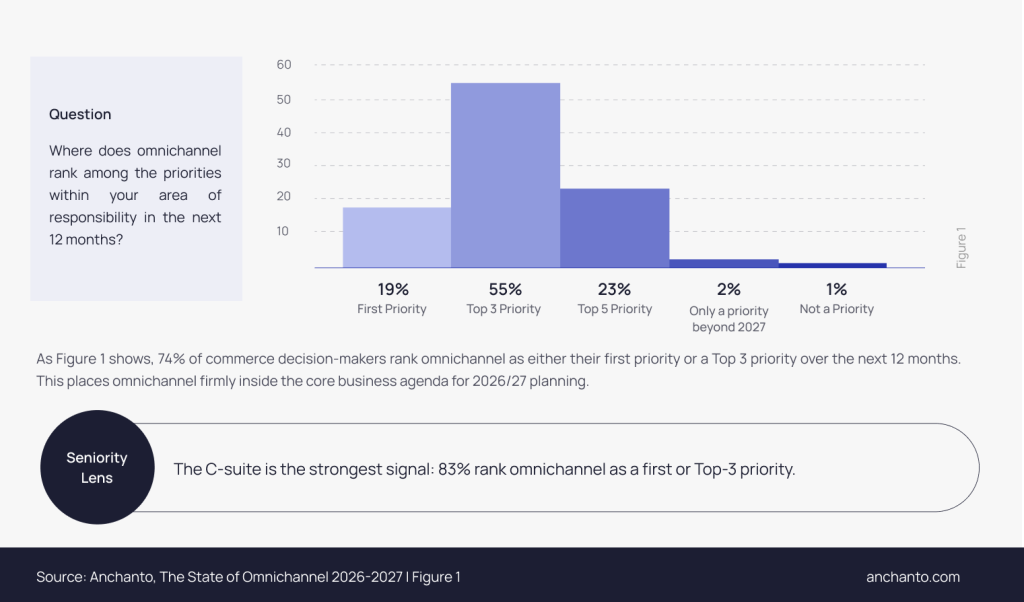
Figure 1: Where omnichannel ranks among priorities for the next 12 months. 74% of commerce decision-makers rank omnichannel as their first priority (19%) or a top-three priority (55%) for the next 12 months. A further 23% rank it top five, 2% only beyond 2027 and 1% not at all. Among the C-suite, 83% rank it first or top three. Source: Anchanto and Demand Metric, The State of Omnichannel Commerce 2026/27, survey of 408 commerce decision-makers.
2. Why AI and Cost Cutting are Now the Same Conversation
We asked commerce decision-makers to rank their top transformation initiatives for the next 12 to 24 months. AI and data capabilities (53%) and cost reduction and efficiency (46%) came out on top.
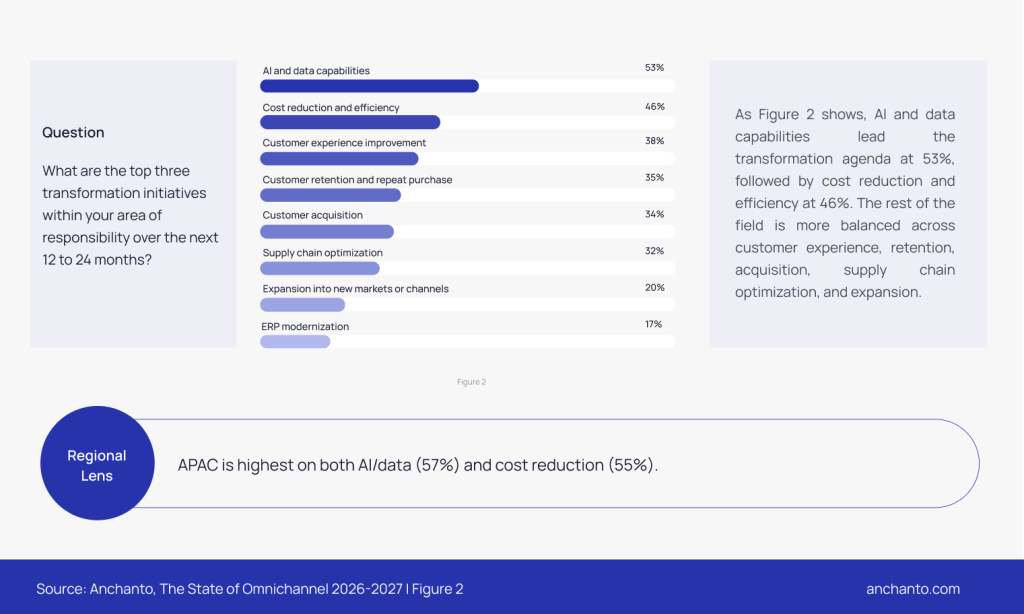
Figure 2: Top transformation initiatives for the next 12 to 24 months. AI and data capabilities (53%) and cost reduction and efficiency (46%) lead the transformation agenda, followed by customer experience improvement (38%), retention and repeat purchase (35%), customer acquisition (34%), supply chain optimisation (32%), expansion into new markets or channels (20%) and ERP modernisation (17%). APAC is highest on both AI and data (57%) and cost reduction (55%). Source: Anchanto, The State of Omnichannel Commerce 2026/27, survey of 408 commerce decision-makers.
AI is moving into everyday commerce decisions like pricing, promotions, inventory planning, fulfilment, and marketplace performance. Those are the same decisions that sit at the centre of an omnichannel operating model, and they are also the decisions that quietly drain margin when they go wrong. A promotion priced against the wrong stock level. A warehouse order placed on outdated demand data. Each one is a small decision, repeated constantly, across every channel a business sells through.
That is why we see AI and cost efficiency as one conversation rather than two. The payoff comes less from cutting a big line item and more from getting thousands of small commerce decisions right: protecting margin and reducing revenue leakage. AI does not sit next to omnichannel as a separate initiative. It works inside the omnichannel operating model, but only as well as the data and workflows underneath it. As the report puts it, AI’s value grows once the operating foundation is connected, not before. Get that foundation right, and better decisions follow, improving the customer experience and protecting margin.
3. Confidence is High. Execution is a Different Question
Satisfaction with current omnichannel performance is high across the board: 86% of organisations say they are satisfied or better with how omnichannel is performing today. Organisations are investing in AI, data, and technology. On paper, this looks like a maturity success story.
But our research also found a major gap between how confident organisations feel and how connected their operations actually are behind that confidence. Only 12% describe their operations as fully optimised. Fewer still, 6%, have true end-to-end visibility across their systems. And 55% say manual effort is still high or very high just to keep orders, inventory, and fulfilment running.
The report shows where the gap is sharpest by region, industry, and seniority.
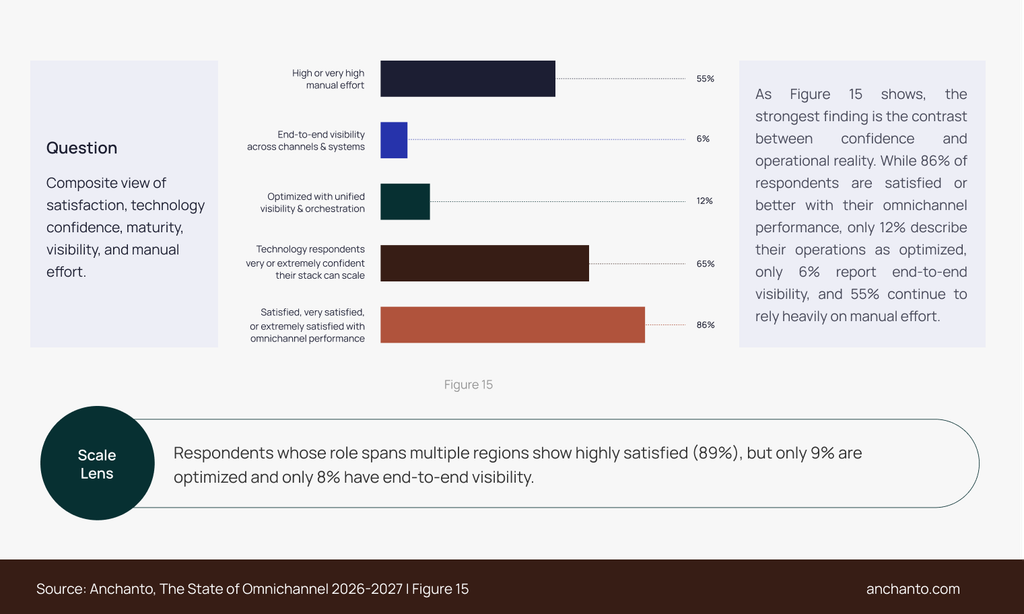
Figure 15: The Omnichannel Execution Gap, confidence versus operational reality. The Omnichannel Execution Gap: 86% are satisfied or better with omnichannel performance and 65% of technology respondents are very or extremely confident their stack can scale, yet only 12% describe their operations as optimised, only 6% have end-to-end visibility and 55% report high or very high manual effort. Source: Anchanto and Demand Metric, The State of Omnichannel Commerce 2026/27, survey of 408 commerce decision-makers.
4. Why the Omnichannel Execution Gap Matters
Confidence in current omnichannel setups pushes companies to keep expanding through more sales channels or markets. That works only if the operating model underneath can keep up. If it cannot, every new channel adds manual effort, disconnected data, and room for the kind of errors that quietly eat into margin and customer experience.
That is the real risk of the execution gap. It does not stop growth. It lets growth outrun the systems supporting it, and the strain shows up in late deliveries, stockouts and cancelled orders, exactly the moments customers notice most.
Closing that gap has to happen alongside the next round of expansion, not after it. Our full report, The State of Omnichannel Commerce 2026/27, shows how the execution gap varies across regions, industries, seniority levels and multi-region roles, so you can see where your organisation’s confidence might be running ahead of its systems.
Download the full report here!FAQs
1. Why has omnichannel become a business priority?
Because omnichannel now shapes customer experience, margin protection, marketplace growth, fulfilment reliability and data visibility at the same time.
2. What are the main omnichannel trends for 2026/27?
AI and data capabilities (53%) and cost reduction and efficiency (46%) lead the transformation agenda for the next 12 to 24 months. AI is moving into pricing, promotions, inventory planning, fulfilment and marketplace performance, the same everyday decisions that sit at the centre of an omnichannel operating model.
3. What is the omnichannel execution gap?
It is the gap between how confident organisations feel about omnichannel and how connected their operations actually are. 86% are satisfied with omnichannel performance, yet only 12% describe their operations as optimised, only 6% have end-to-end visibility and 55% report high or very high manual effort.
4. Where should an omnichannel business strategy implementation start?
Alongside expansion, not after it, with two steps. First, define the omnichannel ambition, such as growth, retention or cost reduction, so that investment is tied to a business outcome. Second, compare how confident and satisfied your teams feel with how optimised, visible and manual your operations really are.
About the data.
The State of Omnichannel Commerce 2026/27 is based on a global survey of 408 qualified commerce decision-makers (395 complete and 13 partial responses) at organisations with annual revenue above US$ 100 million, run by Anchanto with Demand Metric. Respondents are directly involved in commerce strategy, technology or operations, and are split across the Americas (27%), Europe (27%), APAC (25%) and the Middle East and Africa (21%).