
Omnichannel Fulfilment: A Complete Guide for Retailers (2026)
Blogs
Key takeaways
- Consumers today browse, compare, and buy across touchpoints and expect a seamless experience every time. To deliver on this expectation, omnichannel fulfilment is a top priority for retailers.
- Omnichannel customers are worth 30% more over their lifetime, and selling across three or more channels drives dramatically higher engagement.
- Supporting omnichannel retail requires real-time visibility, centralised management, and fulfilment to include warehouse dispatch and ship-from-store and BOPIS.
- The hard part is execution. Inventory accuracy, system integration, and balancing speed with cost are where most retailers hit a wall.
- The OMS is what holds it all together, connecting channels, routing orders, and keeping inventory in sync across your entire network.
Omnichannel fulfilment is how retailers deliver on the promise of a seamless shopping experience. Customers already move between websites, apps, marketplaces, and physical stores during a single purchase journey. A Harvard Business Review study of 46,000 shoppers found that 73% used multiple channels when shopping [1]. The operational challenge is making sure inventory, orders, and delivery work together across all of those touchpoints.
This guide explains what omnichannel fulfilment is, how it works, what systems it requires, and how to build an omnichannel fulfilment strategy that supports growth without creating operational fragmentation.
1. What is omnichannel fulfilment?
It is a unified approach to processing and delivering orders across all sales channels, including online stores, physical retail, mobile apps, and third-party marketplaces, from a single, connected inventory and order management system. Unlike siloed fulfilment where each channel operates independently, omnichannel fulfilment treats all stock as one pool and routes orders to the most effective fulfilment location based on availability, proximity, and cost.
The goal is to give customers flexibility in how they buy and receive products, whether ship to home, pick up in store, or collect from a local point, while giving the retailer a single view of inventory and orders across the entire network.
2. Why omnichannel fulfilment is critical for retailers
Omnichannel fulfilment is critical because customers already shop across channels, and they spend more when they do. A report found that omnichannel customers deliver a 30% higher lifetime value, and retailers supporting three or more channels increase consumer engagement by 250% compared to single-channel competitors [2].
As many as 90% of global consumers between 18 and 44 years old want an omnichannel purchase experience, and many of them start their purchase journey online. [3]
Beyond revenue, omnichannel fulfilment helps retailers reduce stockouts by making inventory available across channels, lower shipping costs by fulfilling from the nearest location, and improve customer retention by offering flexible delivery and pickup options.
3. How omnichannel fulfilment works
Omnichannel fulfilment connects inventory visibility, order routing, and delivery execution into a single workflow. While the specifics vary by retailer, the process generally follows these stages.
- Order capture: Orders arrive from multiple channels, including website, app, marketplace, or in-store, and flow into a centralised order management system.
- Inventory check: The system checks real-time stock availability across all locations, including warehouses, stores, and third-party fulfilment centers.
- Order routing: Based on rules around proximity, cost, stock levels, and delivery speed, the system routes the order to the best fulfilment location.
- Fulfilment execution: The order is picked, packed, and shipped from the assigned location, whether that is a distribution centre, a retail store acting as a micro fulfilment hub, or a 3PL partner.
- Delivery and post-purchase: The customer receives the order through their chosen method, whether home delivery, in-store pickup, or curbside collection, with tracking visibility throughout.
4. Types of omnichannel fulfilment models
Retailers typically combine several fulfilment models depending on their store network, customer expectations, and delivery economics.
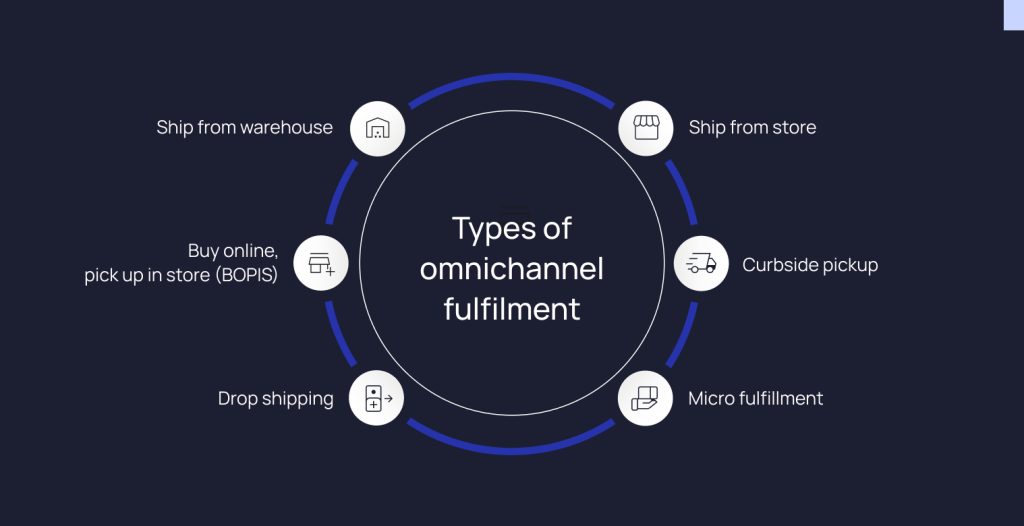
- Ship from warehouse: This is the traditional model where orders are fulfilled from a centralised distribution centre. It is best for high-volume, predictable demand.
- Ship from store: Retail stores act as fulfilment nodes for online orders, reducing last-mile delivery distance and cost. This model has become a cornerstone of omnichannel fulfilment for major retailers.
- Buy online, pick up in store (BOPIS): This involves customers ordering online and collecting their purchase from a nearby store. The global BOPIS Market is projected to be worth US$ 18.26 million in 2026 and reach US$ 39.97 million by 2035 [4].
- Curbside pickup: This is a variation of the BOPIS model where customers collect their orders without entering the store.
- Drop shipping: In this case, orders are fulfilled directly by a supplier or vendor, bypassing the retailer’s own inventory entirely.
- Micro fulfilment: It refers to the fulfilment of orders by small, automated fulfilment centres located close to customers, often within or adjacent to existing stores, designed for fast local delivery.
Recent Digital Commerce 360 reporting shows that in-store stock status remains an increasingly adopted omnichannel feature, with 65.5% of Top 1000 retail chains offering it in 2024, up from 64.4% in 2023 [5]. That kind of visibility, showing customers what is available and where, is the foundation that models like BOPIS and ship-from-store depend on.
5. Key components of an omnichannel fulfilment system
An effective omnichannel fulfilment system requires several connected technology layers.
- Order management system (OMS): This is the central hub that captures orders from all channels, applies routing rules, allocates inventory, and manages exceptions. Anchanto’s order management solution connects order flows, inventory allocation, and fulfilment logic across channels in a single platform.
- Inventory management: Real-time inventory management solution manages stock across all warehouses, stores, and partners, so every channel draws from accurate, unified stock data.
- Warehouse management system (WMS): A WMS solution helps manage warehouse operations, including receiving, storage, picking, packing, and dispatch.
- Channel integrations: These are API connectors that link the OMS to marketplaces, e-commerce platforms, POS systems, and logistics providers.
- Analytics and reporting: The right analytics and reporting systems offer visibility into order fulfilment performance, inventory turnover, and channel-level economics to support better planning and fulfilment cost reduction.
6. Omnichannel fulfilment vs multichannel fulfilment
Multichannel fulfilment means selling and fulfilling through multiple channels, but each channel typically operates with its own inventory, systems, and processes. A retailer might sell on its website and through a marketplace, but manage stock and orders for each separately.
Omnichannel fulfilment connects those channels into a unified system. Inventory is shared, orders are routed centrally, and the customer experience is consistent regardless of where or how they shop. The key difference is integration: multichannel is parallel, omnichannel is connected.
| Factor | Multichannel | Omnichannel |
| Inventory | Separate pools per channel | Unified across all channels |
| Order routing | Channel-specific | Centralised, rule-based |
| Customer experience | Varies by channel | Consistent across channels |
| Systems | Siloed | Integrated via OMS |
| Flexibility | Limited cross-channel options | BOPIS, ship-from-store, curbside |
7. Omnichannel fulfilment strategies for e-commerce brands
Building an effective omnichannel fulfilment strategy starts with understanding where your customers are, what they expect, and what your current operations can support.
a. Start with inventory visibility
You cannot route orders intelligently if you do not know what stock is available and where. Centralising inventory data across all locations is the first and most important step.
b. Match fulfilment models to customer expectations
Not every brand needs every model. A digitally native brand expanding into retail might start with ship-from-warehouse and BOPIS. A legacy retailer with a large store network might prioritise ship-from-store.
c. Use order routing to balance speed and cost
Routing rules should factor in proximity to the customer, stock availability, shipping cost, and fulfilment capacity at each location.
d. Integrate existing channels before adding new ones
Adding a new marketplace or store format creates complexity. Make sure existing channels are connected and performing well before expanding.
e. Measure by outcome, not by channel
Track total fulfilment cost, delivery speed, order accuracy, and customer satisfaction across the network, not in channel silos.
8. How to implement omnichannel fulfilment
Implementation works best as a phased rollout rather than a single transformation. A practical approach includes the following steps.
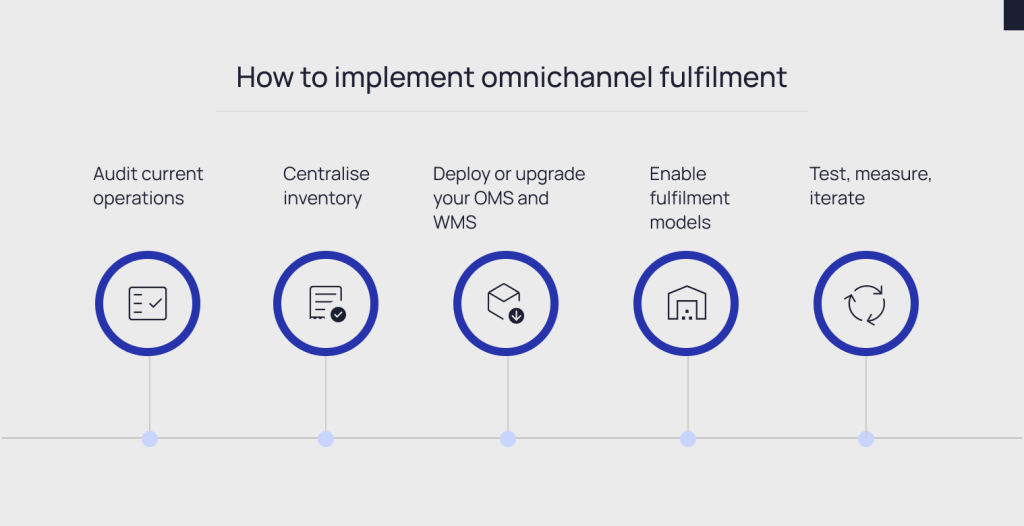
- Audit current operations: Map your existing channels, inventory locations, fulfilment workflows, and system integrations. Identify gaps in visibility, routing, and data flow.
- Centralise inventory: Connect all stock locations into a single inventory view. This is the foundation on which everything else depends.
- Deploy or upgrade your OMS and WMS: Choose an OMS and WMS that supports omnichannel fulfilment. They should be capable of multi-channel order capture, real-time inventory allocation, and configurable routing rules.
- Enable fulfilment models: Start with the models that deliver the most value for your customer base and network, typically ship-from-warehouse and BOPIS, then expand to ship-from-store, curbside, or micro fulfilment as operations mature.
- Test, measure, iterate: Track order accuracy, delivery time, fulfilment cost per order, and customer feedback. Use this data to refine routing rules and expand the model.
Omnichannel fulfilment is where customer expectations meet operational execution. Retailers that unify inventory, connect channels, and route orders intelligently are better positioned to compete on speed, cost, and experience.
The foundation is a connected system, starting with inventory visibility and order management, that scales as the business adds channels, locations, and fulfilment models.
Anchanto’s order management and warehouse management solutions help retailers centralise omnichannel order fulfilment, connect inventory across locations, and build fulfilment workflows that grow with the business.
FAQs
1. Why is omnichannel fulfilment important?
Omnichannel fulfilment is important because customers shop across multiple channels and expect consistent availability, delivery options, and service regardless of where they buy. Retailers that unify fulfilment across channels tend to see higher customer lifetime value and stronger retention.
2. What systems are required for omnichannel fulfilment?
At minimum, an OMS, inventory management system, and WMS, connected through integrations to marketplaces, ecommerce platforms, POS, and logistics providers. The OMS is the most critical layer because it controls order routing and inventory allocation across channels.
3. How is omnichannel fulfilment different from multichannel fulfilment?
Multichannel fulfilment operates each channel separately with its own inventory and processes. Omnichannel fulfilment connects all channels into a unified system with shared inventory, centralised order routing, and a consistent customer experience.
4. What industries benefit most from omnichannel fulfilment?
Retail, fashion, consumer electronics, grocery, and health and beauty are the most common adopters. Any industry where customers expect to browse, buy, and receive products across multiple touchpoints benefits from an omnichannel approach.
5. What is the difference between order orchestration and omnichannel fulfilment?
Order orchestration is the logic layer within omnichannel fulfilment. It determines which location fulfills an order based on rules around stock, proximity, cost, and capacity. Omnichannel fulfilment is the broader operational model that includes order orchestration alongside inventory management, channel integration, and delivery execution.
References:
[1] Hbr.org – A Study of 46,000 Shoppers Shows That Omnichannel Retailing Works
[2] Supplychainbrain.com – The Future of Retail Omnichannel Fulfillment