
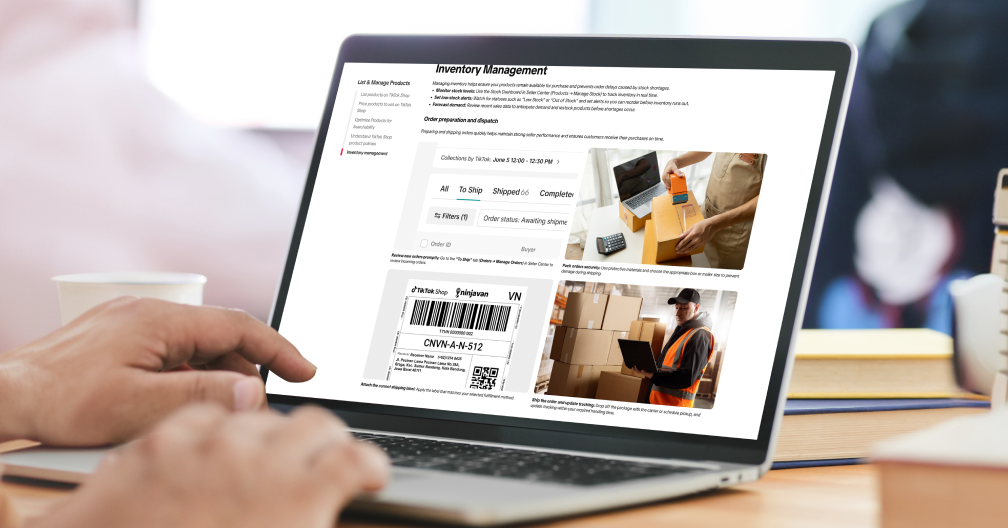
Key Highlights
- Late or cancelled orders lower how often TikTok shows your product, so slow fulfilment cuts future sales as well as today’s orders.
- The fulfillment options available are Seller Shipping, TikTok Shipping, and Fulfilled by TikTok (FBT).
- In the US, regular orders must be scanned by a carrier within 2 business days, and TikTok may take action once late dispatches pass 10%. [2] Other markets set their own rules, so check your local Seller Center.
- Overselling happens when stock counts lag between channels. A single stock count that updates every channel as sales happen stops the same unit selling twice.
- A 3PL suits custom packaging, kitting, and stock across several countries. On TikTok Shipping it must print TikTok-issued labels, and on Seller Shipping it must upload valid tracking for every order.
On TikTok Shop, a viral video is only good news if the orders ship on time. Scroll through TikTok in Jakarta, London, São Paulo, or Los Angeles today and you will see the same thing. Products are demonstrated, reviewed, and bought without anyone leaving the app. TikTok Shop has compressed the distance between content and checkout, and the commercial results are significant. According to Momentum Works, TikTok Shop’s global gross merchandise value (GMV) reached US$ 64.3 billion in 2025, up 94% year on year across 16 markets. [1]
Fulfilment is where that growth gets tested. On TikTok Shop, one viral video can multiply orders overnight, and every order that misses its dispatch deadline counts against your seller metrics straight away. Late orders lower how often TikTok shows your products, and if they keep happening, TikTok can limit orders or suspend the shop.
This guide covers the three ways to fulfil TikTok Shop orders, the metrics TikTok enforces, and how to keep up when a video takes off. TikTok sets TikTok Shop shipping deadlines and metric targets market by market. We use the US as the worked example because its policies are published in full. Check your local Seller Center for the exact numbers where you sell.
1. What Is TikTok Shop Fulfilment?
TikTok Shop fulfilment is the end-to-end process of moving a product from a seller’s inventory into a customer’s hands after a purchase in the app. It covers storage, order processing, picking, packing, and last-mile delivery. Sellers can manage this themselves, hand it to TikTok’s in-house service, or route it through a third-party logistics (3PL) provider. The choice affects shipping speed, cost, and how much control the seller keeps.
The real decision is which model fits your stock, and whether your systems can take a sudden spike.
Fulfilment affects visibility
Missing TikTok’s targets costs more than the order. In the US, sellers with an On-Time Delivery Rate under 80% or a Late Dispatch Rate over 10% can see TikTok limit their orders, cut their visibility, or suspend the shop. [2]
TikTok’s own US data shows the same product converted 15% to 20% better when it carried the “Free 3-Day Delivery” tag that eligible FBT products get. [3] Moreover, delivery speed shows on the listing, so it moves sales directly.
2. How TikTok Shop Fulfilment Works
TikTok Shop fulfilment follows a fixed order lifecycle from payment to delivery, and each stage has a deadline set in TikTok’s Fulfillment Policy. [2] Missing one feeds straight into your seller metrics. Whether you hit the deadlines comes down to two things: how fast your team moves an order through each stage, and whether the stock you promised is actually there.
a. The order lifecycle
When a customer completes a purchase, the order enters “Awaiting Shipment”. As a seller, or TikTok, for FBT orders, the order is prepared and tracking is added, which moves it to “Awaiting Collection”. The time between these two statuses is your handling time. You set it, but in the US the default for regular orders is 1 to 2 business days. [2]
In the US, the carrier must scan the package within 2 business days of “Awaiting Shipment”, which moves it to “In Transit”. Orders that miss this count towards your Late Dispatch Rate. The table shows each status and the US deadline TikTok measures it against. [2]
| Status | What triggers it | US deadline (from “Awaiting Shipment”) |
| Awaiting Shipment | Payment confirmed | Clock starts |
| Awaiting Collection | Seller adds tracking | Within 5 business days, or the order is cancelled automatically |
| In Transit | Carrier scans the package | Within 2 business days, or it counts as a late dispatch |
| Delivered | Carrier confirms delivery | Within 6 business days |
b. Where inventory visibility fits in
Most oversells begin before anyone touches a box. During a spike, a sale on one channel (TikTok Shop, Amazon, eBay, etc.,) can take hours to reach the others. That lag causes oversells, cancellations, and late dispatches, right when the product has the most attention.
Centralising order and inventory data through a connected order management system (OMS) closes that gap at the source. Every sale on every channel updates available stock in real-time, so TikTok Shop orders are checked against live inventory.
3. TikTok Shop Fulfilment Options
In February 2026, TikTok Shop dropped a plan to move most US sellers onto its own logistics after brands pushed back. [4] Seller Shipping stayed, but TikTok now says it may only be available to select US sellers, [5] so check your eligibility before you build around it. There are three TikTok Shop shipping options at the moment:
- Seller Shipping. Sellers use their own carriers or a 3PL.
- TikTok Shipping. Sellers fulfil from their own warehouse but use TikTok’s labels and carrier network.
- Fulfilled by TikTok (FBT). TikTok manages storage, picking, packing, and last-mile delivery entirely. [5]
a. Seller shipping
With Seller Shipping, the seller picks their own logistics provider, prints their own labels, and runs pick, pack, and ship either in-house or through a 3PL. [5] This suits sellers who already run fulfilment for other channels and want TikTok Shop orders in the same workflow. In the US, check your eligibility in the Seller Center first. [5]
The trade-off is full metric accountability. Late Dispatch Rate, On-Time Delivery Rate, Valid Tracking Rate, and Seller-Fault Cancellation Rate all apply in full. [2] Sellers on this route need systems that can absorb volume spikes without missing service level agreement (SLA) windows.
b. TikTok shipping
TikTok Shipping lets you keep fulfilling from your own warehouse while using TikTok-negotiated carrier rates and TikTok-issued labels. It is available for US domestic warehouses only. [6] TikTok picks the carrier for each order. You print the label in the Seller Center or through an approved integration, then hand the package to that carrier. In parts of the US, Collection by TikTok (CBT) adds free pickup from your warehouse, which TikTok says can cost up to 40% less than Standard Delivery. [6]
If the seller dispatches on time, delivery delays caused by TikTok’s carriers are excluded from On-Time Delivery Rate and Negative Review Rate penalties. [6] That makes TikTok Shipping a middle path for sellers who want some of FBT’s protection without sending inventory to TikTok’s warehouses.
c. Fulfilled by TikTok (FBT)
FBT is TikTok’s own warehousing and fulfilment programme. Sellers send inventory to TikTok’s fulfilment centres, and TikTok handles storage, picking, packing, and last-mile delivery. In the US, eligible FBT products carry a “Free 3-Day Delivery” tag and are processed within 24 hours of an order. [3]
FBT orders are excluded from Late Dispatch Rate, On-Time Delivery Rate, and Valid Tracking Rate, so a spike in FBT orders doesn’t put those metrics at risk. [2] The trade-off is control. Stock has to sit in TikTok’s warehouses before it can sell, so a viral product can sell out there while units sit in your own warehouse. [4] FBT also doesn’t offer kitting, so physical bundles must arrive pre-packed. [7]
What this means for you
If your product has consistent, forecastable demand and you sell mainly in the US, FBT is often the most straightforward starting point. If you need custom packaging, kitting, or one stock pool across several countries, TikTok Shipping or Seller Shipping with a well-integrated 3PL usually gives you more flexibility.
4. Key Requirements for Successful TikTok Shop Fulfilment
Meeting TikTok’s fulfilment requirements means hitting dispatch and delivery deadlines, keeping valid tracking on every order, and keeping stock accurate enough to avoid seller-fault cancellations. Each one has a hard target. In the US, TikTok expects at least 95% valid tracking, at least 80% on-time delivery, and no more than 2.5% seller-fault cancellations. [2] Miss them and TikTok can deduct Account Health points, limit order volume, or suspend the shop. [2]
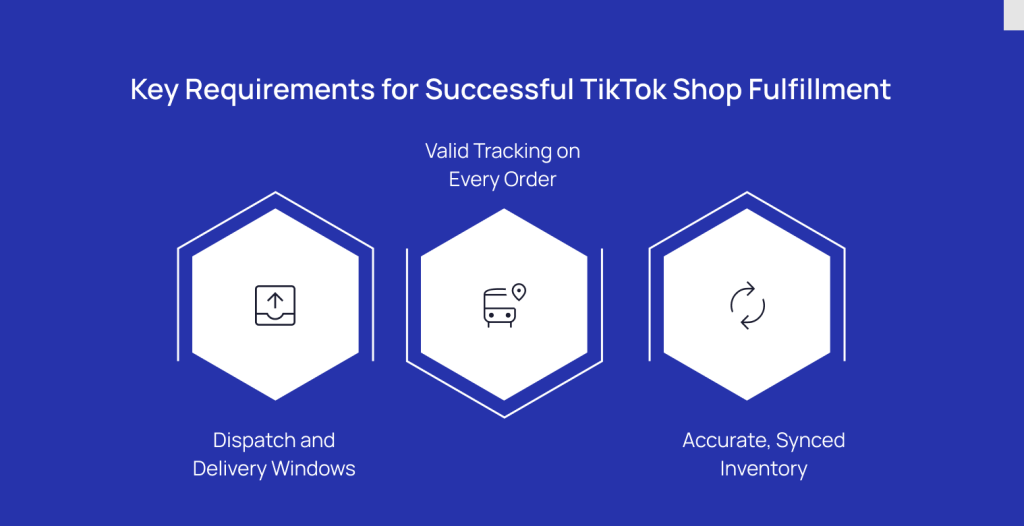
a. Dispatch and delivery windows
In the US, sellers set a handling time of 1 to 2 business days for regular orders, counted from “Awaiting Shipment” to “Awaiting Collection”. Pre-orders, made-to-order products, and custom shipments can have longer windows. [2] Late Dispatch Rate measures orders not scanned by a carrier within 2 business days. TikTok recommends keeping it at 4% or below and may take action if the Late Dispatch Rate is above 10%. [2]
b. Valid tracking on every order
Every order needs a tracking number that updates accurately and reflects real package movement. TikTok measures this through its Valid Tracking Rate. FBT and TikTok Shipping orders don’t count towards it, because TikTok adds the tracking itself. Seller Shipping orders count in full. [2]
c. Accurate, synced inventory
Seller-fault cancellations usually come from stock counts that are out of date. That makes it essential to maintain real-time inventory updates. The inventory section below explains how to do this.
5. Common TikTok Shop Fulfilment Challenges
The most common TikTok Shop fulfilment challenges come from the platform’s demand pattern rather than logistics unique to TikTok. Sellers already running structured operations for other channels often underestimate how quickly that pattern exposes gaps in their systems.
a. Viral demand spikes
According to GlobalData, 70% of TikTok Shop consumers have purchased a creator-recommended product. [8] On TikTok Shop, discovery and checkout sit in the same app, so views can turn into orders within hours.
A viral video can, for example, take a product from 50 orders a day to several hundred within hours, with no warning. In a situation like this, manual processing breaks first. If staff pick from printed lists, a jump that size means orders miss the 2-business-day dispatch window. The result is a wave of late dispatches that pushes your metrics towards enforcement.
b. Multichannel inventory conflicts
Sellers running TikTok Shop alongside other marketplaces or their own webstore without centralised inventory often oversell, because stock levels don’t update across channels in real time. This is worse if you’re selling in several countries, where marketplace accounts in different countries draw on the same physical stock without knowing what the others have sold. If one channel’s sale doesn’t reach the others straight away, the same unit can sell twice. The second order gets cancelled and counts against your Seller-Fault Cancellation Rate.
c. Software and integration compatibility
Not every warehouse management system, enterprise resource planning (ERP) tool, or shipping platform integrates cleanly with TikTok’s label formats and tracking flows. If your warehouse system or shipping tool can’t pull TikTok Shipping labels or push tracking to Seller Center, someone does it by hand for every order. On Seller Shipping, each missed upload counts against Valid Tracking Rate.
6. Best Practices for TikTok Shop Fulfilment
The most reliable TikTok Shop order fulfilment setups share a few structural habits. The five habits below keep Late Dispatch Rate and Seller-Fault Cancellation Rate in range when order volume jumps.
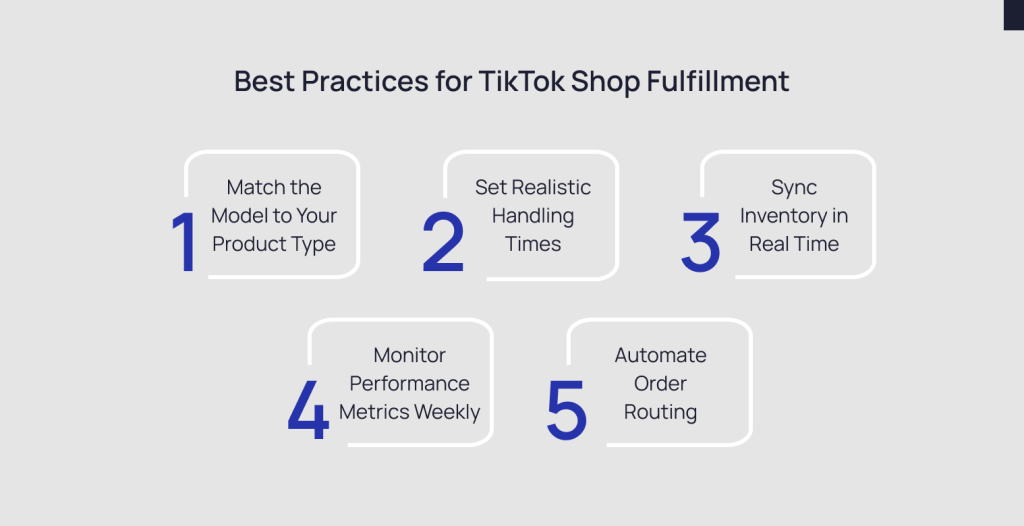
a. Match the model to your product type
The best fulfilment services for TikTok Shop sellers depend on your product and order volume, so start by matching the model to both. High-velocity, lightweight stock-keeping units (SKUs) with predictable demand often suit FBT. If your products need more control, the 3PL section below covers when another route fits better.
b. Set realistic handling time
Set handling time that reflects real warehouse capacity, including buffers for high-demand periods, rather than the tightest possible window. Missed deadlines turn straight into Late Dispatch Rate penalties.
c. Sync inventory in real time
Sync inventory across every connected sales channel so each TikTok Shop order is checked against live stock.
d. Monitor performance metrics weekly
Check TikTok’s four seller metrics every week. They are Late Dispatch Rate, On-Time Delivery Rate, Valid Tracking Rate, and Seller-Fault Cancellation Rate. On-Time Delivery Rate is calculated weekly, and TikTok’s own Late Dispatch Rate example looks back 30 days, so one bad week can stay on your record. [2]
e. Automate order routing
Use automated order routing to send TikTok Shop orders to the nearest or cheapest fulfilment location without manual work, especially if you run warehouses in more than one region.
Case in point
Indonesian skincare brand ERHA sells on TikTok, Shopee, Tokopedia, and Zalora. Processing orders by hand capped it at 300 orders a day. After moving to Anchanto Order Management and Warehouse Management, it fulfilled over 1,000 orders in the same 8-hour day without adding staff. It also processed every order received before 3 PM on the same day. [9]
ERHA’s limit was manual order processing. TikTok Shop sellers hit the same limit when a video takes off. Read the ERHA case study to see how it scaled without growing its team.
7. TikTok Shop Fulfilment and Inventory Management
Inventory management is the base every other step of TikTok Shop order fulfilment rests on. Every TikTok Shop order depends on knowing how much stock you have, and in which warehouse, the moment an order comes in.
Why inventory accuracy is the real bottleneck
Late dispatches and cancellations often begin upstream, with stock data that is stale or split across systems. If you update stock counts manually across TikTok Shop, a webstore, and marketplaces in several regions, you are always a step behind your real inventory. That gap is manageable at a low, predictable volume. It becomes a serious liability the moment demand spikes.
Real-time inventory synchronisation, the kind built into a connected order management system, allocates stock as sales happen across every channel at once. When a buyer on TikTok Shop sees a product listed as available, the count reflects the stock you actually hold. Without it, a viral spike turns into days of cancellations.
8. How 3PLs Support TikTok Shop Fulfilment
A 3PL stores, picks, packs, and ships for you. The same stock can serve your other sales channels, and a 3PL with warehouses in several countries can cover markets FBT doesn’t. Its edge over FBT is reach and control. It can handle custom packaging and kitting.
a. When a 3PL makes more sense than FBT
Brands with custom packaging, kits that need assembling, or stock spread across several countries usually get more flexibility from a well-integrated 3PL. The condition is technical. On TikTok Shipping, the 3PL must print TikTok-issued labels. On Seller Shipping, it must upload valid tracking for every order. A 3PL that can’t do either automatically falls back to manual order entry, which doesn’t scale.
b. What to look for in a TikTok-ready 3PL
Choosing the best fulfilment services for TikTok Shop sellers comes down to one requirement above all. The provider’s systems must connect directly to TikTok’s label and tracking flows. A warehouse management system connected to an OMS picks, packs, and ships TikTok Shop orders in the same queue as every other channel, instead of treating TikTok as a separate, manual workflow.
9. TikTok Shop Fulfilment for Omnichannel Sellers
For brands selling across several channels and markets, TikTok Shop fulfilment works best as one part of a connected operation rather than a channel with its own separate systems. The two sections below show what running it separately costs, and what a connected setup looks like.
a. The cost of treating TikTok Shop as a silo
Running TikTok Shop fulfilment on separate stock checks and order queues works at low order volumes. When orders spike, the TikTok queue falls behind, late dispatches pile up, and Late Dispatch Rate climbs towards the 10% line where TikTok can act. [2]
b. The connected fulfilment advantage
A connected fulfilment setup pulls TikTok Shop orders into the same queue as every other sales channel, checks each order against a single inventory pool, and routes it to the right warehouse by location, cost, or priority. This is what Anchanto’s Order Management System is built for. It centralises order orchestration through 70+ sales channel integrations, so TikTok Shop becomes one more connected channel rather than a separate operation.
10. Scaling TikTok Shop Fulfilment as Your Business Grows
Scaling TikTok Shop fulfilment means moving from manual processes to automated order routing, predictive inventory planning, and infrastructure that flexes with TikTok’s uneven demand. Below are the signs you’ve outgrown manual work, how to plan for spikes, and what changes when you sell in more than one region.
a. Recognising when you have outgrown manual processes
A few signals tend to appear together. Order processing that used to take minutes now takes hours, stock discrepancies come up every week, and Late Dispatch Rate or Seller-Fault Cancellation Rate is moving towards TikTok’s enforcement thresholds. When any of these appear, scale the systems behind fulfilment before you add headcount.
b. Building for volatility
TikTok Shop demand doesn’t grow in a straight line. It arrives in spikes on top of gradual growth, driven by content performance no one can predict precisely. A TikTok Shop fulfilment setup built for average daily volume will struggle the moment a product goes viral. If you set buffer stock thresholds, automate reorder triggers, and use smart order routing to send orders to the most efficient location, you can absorb spikes without missing deadlines.
c. Planning for multi-region growth
When planning cross-border or multi-region operations, you need fulfilment infrastructure that manages different shipping timelines, carriers, and regional rules from one view. Connect every regional warehouse, carrier, and sales channel to one system from the start with enterprise integrations. Retrofitting a single-warehouse setup after you’ve outgrown it is much harder.
11. Conclusion
On TikTok Shop, fulfilment speed affects how often TikTok shows your products, as well as how fast they arrive. Whichever route you choose, it holds up as orders grow only if order and stock data move between your channels fast and accurately.
Sellers who run TikTok Shop through the same order and stock system as their other channels can take a viral spike without missing TikTok’s deadlines.
Want TikTok Shop orders running through the same system as your other channels?
See how Anchanto’s Order Management System puts TikTok Shop orders in the same queue as your other channels, with orders and stock synced in real time.
Book a DemoFAQs
1. What is Fulfilled by TikTok (FBT)?
Fulfilled by TikTok is TikTok’s in-house warehousing and fulfilment service. Sellers send inventory to TikTok’s fulfilment centres, and TikTok handles storage, picking, packing, and last-mile delivery. Logistics issues on FBT orders are kept out of seller metrics, and eligible products carry a “Free 3-Day Delivery” tag. [3]
2. Can sellers use a 3PL for TikTok Shop fulfilment?
Yes. With TikTok Shipping, the 3PL prints TikTok-issued labels and TikTok adds the tracking. [6] With Seller Shipping, the 3PL uses its own carriers and must upload valid tracking for every order. In the US, TikTok says Seller Shipping may only be available to select sellers. [5]
3. What software is needed for TikTok Shop fulfilment?
At minimum, sellers need a system that syncs orders and inventory between TikTok Shop and their other sales channels, generates compliant shipping labels, and updates tracking automatically. For sellers managing several channels or markets, an order management system with a native TikTok Shop integration makes this sustainable at scale.
4. What happens if TikTok Shop orders exceed available inventory?
Orders that exceed available stock become seller-fault cancellations, which count against Seller-Fault Cancellation Rate. In the US, TikTok expects that rate to stay at 2.5% or below. Sellers who miss it can face order volume limits or shop suspension. [2]
5. How quickly should TikTok Shop orders be shipped?
In the US, regular orders must be scanned by the carrier (status “In Transit”) within 2 business days of “Awaiting Shipment”. Orders with no tracking after 5 business days are cancelled automatically, and delivery is due within 6 business days. Made-to-order and custom items must be in transit within your handling time plus 1 business day. Pre-orders must be in transit within 2 business days of the pre-order closing. [2]
6. What KPIs should TikTok Shop sellers track?
Sellers should track Late Dispatch Rate, On-Time Delivery Rate, Valid Tracking Rate, and Seller-Fault Cancellation Rate. TikTok uses all four to judge account health and trigger enforcement when targets are missed. [2]