
Retail Inventory Management: Process and Tips to Improve in 2026
Blogs
Retail inventory management has become far more complex as retail businesses today evolve into omnichannel. This involves the unification of inventory across physical outlets, warehouses, and online stores, a shift Salesforce found 88% of retailers now consider critical to their business objectives over the next two years. [1] Returns compound this shift. When a customer buys online and returns in store, it is expected that the item reappears in available stock everywhere, not just wherever it physically landed.
Legacy systems, rarely built for this kind of channel crossing, struggle to keep pace, which is exactly why so many retailers can see their inventory on a dashboard and still not trust the number.
That gap between what the system says and what’s actually on the shelf is the real problem this guide addresses. It walks through what retail inventory management actually involves in 2026, how the process plays out across channels and locations once a retailer has multiple stores, and what it takes to close that visibility gap for good.
1. What is Retail Inventory Management?
Retail inventory management is the end-to-end process of tracking, allocating, replenishing, and controlling stock across stores, warehouses, and sales channels. The goal is to maintain accurate inventory availability while supporting efficient fulfillment and reducing excess stock.
For an enterprise retailer, this means tracking every SKU from the moment it enters a distribution center until it reaches a customer.
When done well, inventory management connects restocking decisions with real demand signals. This ensures stock levels stay balanced so orders can be fulfilled without overselling or tying up excess working capital. If done poorly, retailers will see a higher number of canceled orders (due to insufficient inventory), excess stock eating into margins, and store associates telling customers the system is wrong about what’s available.
Efficient retail inventory management reduces these operational issues by connecting inventory visibility with order and fulfillment workflows across the business.
2. How Retail Inventory Management Works
The process of retail inventory management follows a clear sequence, but it can get complicated fast, especially at scale.
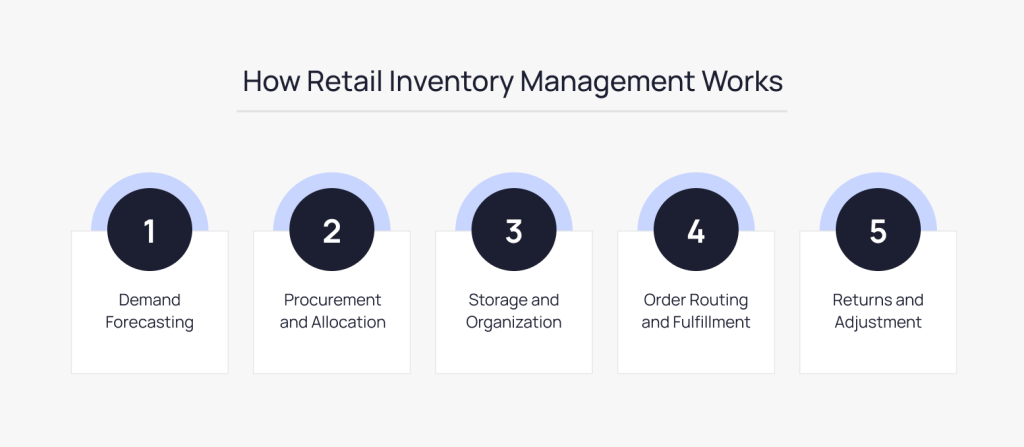
- Demand Forecasting: Retailers predict demand using historical sales data, seasonal trends, campaign schedules, and regional purchasing behavior to guide replenishment and allocation decisions.
- Procurement and Allocation: Once forecasts are established, retailers procure inventory from suppliers and distribute stock across locations based on demand patterns, warehouse capacity, supplier lead time, and fulfillment priorities.
- Storage and Organization: Inventory is assigned across warehouses, storefronts, and fulfillment centers while systems track SKU quantities, product locations, inventory condition, batch details, and expiry dates where applicable.
- Order Routing and Fulfillment: When customers place orders, the system determines the best fulfillment source based on inventory availability, delivery proximity, and operational capacity to reduce split shipments and improve delivery speed.
- Returns and Adjustment: Returned items are inspected, repackaged, and reassigned to inventory, and an accurate record is maintained of the same.
Throughout this cycle, inventory may be transferred between stores to meet local demand or reserved for click-and-collect orders placed online. A robust inventory management strategy ensures these movements update in real time to reduce overselling and fulfillment errors.
3. Types of Retail Inventory Management Systems
Retailers use different retail inventory management systems, depending on operational scale, fulfillment complexity, and technology infrastructure. The differences become more noticeable once businesses operate across stores and online commerce simultaneously as part of their omnichannel business model.
a. POS retail inventory management system
POS (Point of Sale) is often the first tool a retailer uses to track stock, but it mainly focuses on in-store transactions and cannot support real-time inventory synchronization across e-commerce platforms and warehouses on its own. POS systems commonly support:
- Barcode and SKU management.
- Basic stock-level updates.
- Store-level inventory reporting.
- Customer purchase history tracking.
b. ERP-based retail inventory management system
Enterprise Resource Planning (ERP) systems manage inventory to a certain extent alongside broader business functions. However, many ERP solutions aren’t designed for real-time inventory distribution, creating delays between stock movement and visibility. ERP inventory modules work best at supporting:
- Financial reporting.
- Inventory valuation.
- Procurement workflows.
- Supplier management.
c. Dedicated retail inventory management software
Dedicated inventory systems focus entirely on inventory visibility and control, improving operational responsiveness significantly. The challenge appears when inventory systems remain disconnected from order management and fulfillment workflows. A dedicated retail inventory management software improves visibility through:
- Real-time stock tracking.
- Store-level inventory visibility.
- Replenishment coordination.
- Warehouse and storefront synchronization.
4. Key Features of Retail Inventory Management Software
Modern retail inventory management software should do more than basic tracking and reporting. The strongest systems improve operational responsiveness, reduce reconciliation work, and support real-time fulfillment coordination across locations. The top features of these systems are:
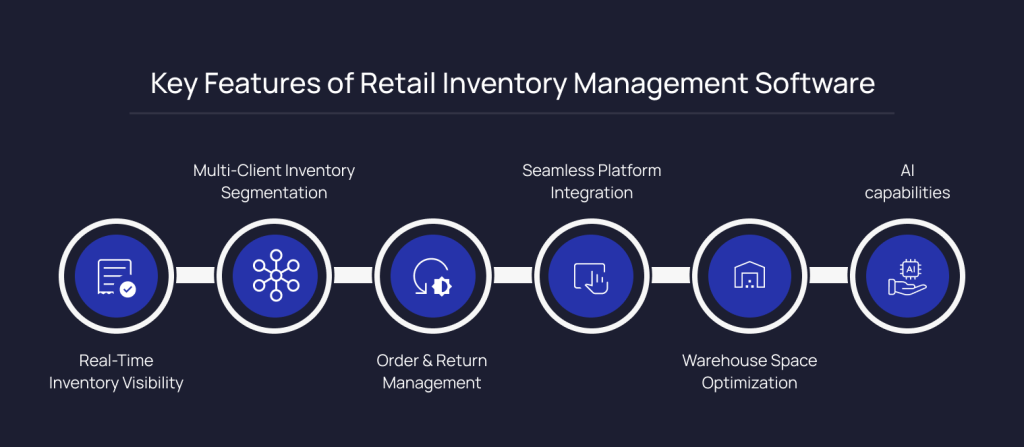
- Real-Time Inventory Visibility: This is the ability to see exactly what’s available at every store, warehouse, and fulfillment center at any moment. This allows retailers to make informed decisions quickly and prevent costly inventory errors.
- Multi-Client Inventory Segmentation: This refers to the ability to manage multiple inventory categories, and even clients in the case of 3PLs, to ensure no mix-up. This promotes accurate and personalized reporting while demonstrating commitment to individual needs.
- Order and Return Management: This involves automation of key steps like return requests, authorization, restocking, inspection, and refund or exchange processing. It helps businesses handle returns faster, minimize errors, and maintain a positive customer experience.
- Scalable Platform Integration: Strong integrations connect with the platforms enterprise retailers actually operate on (for example, Amazon, TikTok Shop, eBay, Shopee, Lazada) alongside SAP, Oracle, and existing POS systems. They create a unified and frictionless ecosystem that works at any scale or location, without requiring a full infrastructure overhaul.
- Warehouse Space Optimization: Features like intelligent slotting, cycle counting optimization, and real-time inventory location tracking are a must to enable optimal storage assignment. With this feature, businesses can maximize warehouse space, while reducing operational costs and improving order fulfillment accuracy.
- AI capabilities: With AI dominating industries, including retail, it’s vital to look for an inventory management system with an Agentic commerce layer to automate repetitive tasks. For example, a replenishment agent will track stock and demand, then auto-create purchase orders before inventory runs out. A fulfilment agent will pick the best warehouse and courier for each order based on cost, speed, or stock location, running end-to-end and looping in a human only for exceptions.
5. Key Challenges of Retail Inventory Management Without Smart Technology
For enterprise retailers, most operational bottlenecks trace back to one root cause: systems that don’t talk to each other. Store inventory sits in a POS, warehouse stock sits in a separate tool, and neither syncs with the online store or marketplace channels in real time. That disconnect shows up across the business in a few consistent ways:
- Inventory Fragmentation: Stock data sits disconnected across POS systems, warehouse tools, and ERPs, and the inaccuracy can lead to order cancellations and failed fulfillments.
- Stockouts: Beyond the immediate lost sale, stockouts add supply chain costs from urgent replenishment and can lower customer retention if the item is unavailable very often.
- Overstocking: Fear of stockouts drives over-ordering, which creates its own set of problems, like excess carrying costs, idle stock, and markdowns or write-offs.
- Campaign Demand: High-traffic events like Prime Days, Mother’s day, or the Holiday season compress high demand into short fulfillment windows, and systems without real-time updates struggle to keep pace.
- Multi-Location Complexity: Managing inventory across multiple retail locations cannot rely on manual overhead alone as it will result in delayed updates and continuous errors.
- Returns Complexity: The process of getting a returned item back into sellable inventory means inspection, restocking, and often repackaging. DHL estimates that this process leaves a $62.5 billion global value pool unrecovered each year from returns that are scrapped or delayed rather than resold. [2] If returns processing takes too long, stock levels can appear lower than they are while this processing plays out.
6. Retail Inventory Management Techniques
Most operations use a combination of retail inventory management techniques to control how stock moves through the system, depending on product category and margin profile. These techniques shape both availability and cost efficiency.
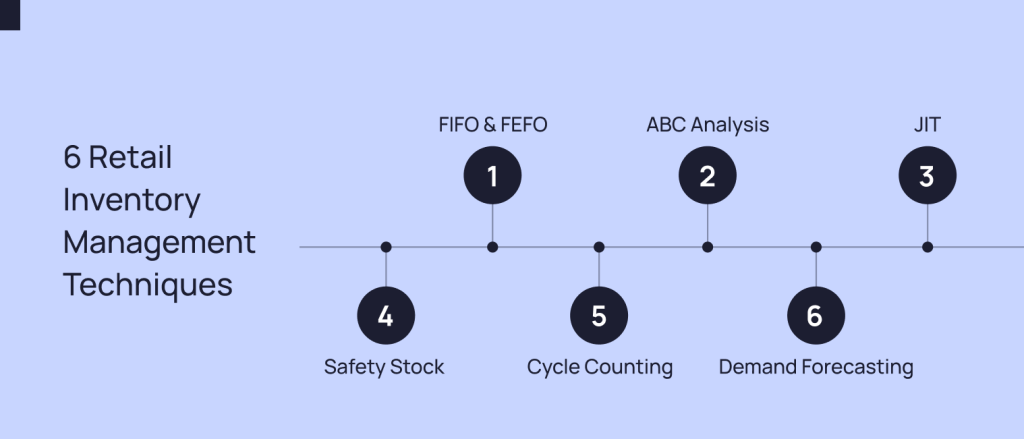
- FIFO and FEFO: First In, First Out (FIFO) ensures older stock is sold before newer stock, while First Expiry, First Out (FEFO) applies to perishable goods to reduce waste.
- ABC Analysis: Inventory is classified into three tiers by sales volume and value, where A generates the highest value and requires close monitoring, B needs regular oversight, while C is low-value and cost control is a priority.
- JIT: Just-In-Time (JIT) focuses on receiving stock closer to actual demand timing to reduce storage costs and excess inventory exposure.
- Safety Stock: Retailers maintain buffer stock that is above the minimum required levels to protect against unexpected demand spikes or supply delays.
- Cycle Counting: Instead of relying on large annual stock audits, cycle counting verifies smaller portions of inventory continuously throughout the year to maintain more accurate records.
- Demand Forecasting: Demand forecasting uses sales data and trends to guide stock planning, which can reduce excess inventory and stockouts.
7. Best Practices for Efficient Retail Inventory Management
Inventory management techniques become more effective when supported by broader operational strategies. For enterprise retailers in 2026, the strongest results usually come from reducing fragmentation and improving coordination across the inventory network.
- A Single Source of Truth
Every store, warehouse, and channel should draw from the same inventory record that’s updated in real time. A unified dashboard centralizes visibility, enabling identification of stock imbalances, reallocation of inventory faster, and improvement of replenishment coordination.
- Perpetual Tracking
Periodic tracking leaves gaps between physical stock and system visibility. Switching to perpetual tracking enables accurate routing, reliable click-and-collect commitments, and proactive replenishment.
- Store as Fulfillment Nodes
Many retailers now fulfill online orders directly from stores to improve delivery speed and increase inventory utilization. However, this only works when store-level inventory accuracy remains consistently reliable.
- Track the Right KPIs
Inventory turnover, stockout rate, order accuracy, and dead stock are the metrics that signal whether the strategy is actually working. Tracking the right KPIs reveals inefficiencies before they become costly problems.
What works for a 10-store regional chain looks different from what a 50+ store national retailer operating across 3+ international markets needs. Getting that match right matters more than applying any single technique in isolation. When implemented correctly, these efforts ensure that capital remains fluid rather than locked in stagnant inventory.
8. Benefits of Effective Retail Inventory Management
When inventory management works, the gains extend beyond stock accuracy into fulfillment, customer experience, and financial performance.
A 2024 McKinsey report on AI in distribution operations [3] found that AI-driven inventory optimization in distribution networks can lead to reductions of 20% to 30% in inventory, 5% to 20% in logistics costs, and 5% to 15% in procurement costs.
The customer-facing benefits are equally significant:
- Accurate stock data improves fulfillment reliability, whether in-store or online and reduces cancellations.
- Faster inventory synchronization improves delivery consistency and strengthens customer retention.
Better inventory visibility also improves broader operational planning. For example, promotional planning, supplier negotiations, and fulfillment network design all get sharper when stock data is accurate and updated in real time.
9. How to Choose the Right Retail Inventory Management System
Retailers need a system that can fulfill orders from wherever makes sense, whether that’s a store, a warehouse, or a specific location, without ripping out the infrastructure they already run on. As a result, choosing the right retail inventory management system comes down to operational fit, not the number of features on a spec sheet.
Ask these questions as you shortlist platforms:
- Does it integrate with your existing stack?
- Does it sync and provide real-time visibility across all locations?
- Can it scale with your location count?
- Does it support multi-region tax and currency requirements?
- What does implementation actually look like?
- What is the uptime during peak campaign periods?
- Does it support your operating model specifically?
An enterprise-grade retail inventory management system should sit alongside your existing infrastructure rather than forcing a full rebuild. This reduces implementation risk and shortens time-to-value for operations teams.
10. Conclusion
As retailers expand into omnichannel operations, retail inventory management needs tighter coordination, as inventory accuracy affects fulfillment reliability, delivery speed, customer experience, and operational efficiency across the business.
The challenge for most retailers is that existing infrastructure isn’t built to work together at the speed modern commerce demands. Closing that gap requires an orchestration layer that connects and enhances the present infrastructure.
Businesses that unify inventory visibility across their sales and fulfillment channels are better positioned to reduce operational overhead, improve fulfillment consistency, and meet customer expectations wherever a sale originates.
If your current infrastructure is struggling to keep pace with your omnichannel retail, it may be time to evaluate how your systems are connected.
Talk to Our TeamFAQs
1. What is the biggest challenge in retail inventory management today?
The biggest challenge is maintaining accurate inventory visibility across stores, warehouses, and sales channels simultaneously. Inventory discrepancies increase quickly when systems update at different speeds.
2. What tools are used for retail inventory management?
Enterprise retailers typically use a combination of an ERP for financial records, a POS for store transactions, and OMS or WMS for real-time order orchestration and warehouse operations.
3. How does inventory management impact profitability?
Inventory management affects profitability through stock availability, inventory carrying costs, markdown exposure, and fulfillment efficiency.
4. When should a retailer invest in retail inventory management software?
The clearest signals are when inventory decisions are made using unreliable data, order fulfillment regularly fails, or a growing location count creates operational complexity that spreadsheets or disconnected systems can’t manage.
5. How can retailers reduce stockouts?
Retailers can reduce stockouts through better forecasting, safety stock planning, real-time inventory synchronization, and distributed fulfillment coordination.
References –
[1] Salesforce.com – The Top Marketing Statistics to Know in 2026
[3] Mckinsey.com – Harnessing the power of AI in distribution operations