
Cross-Border E-Commerce in Southeast Asia: Lessons on Fragmentation, Discounting, and AI
Blogs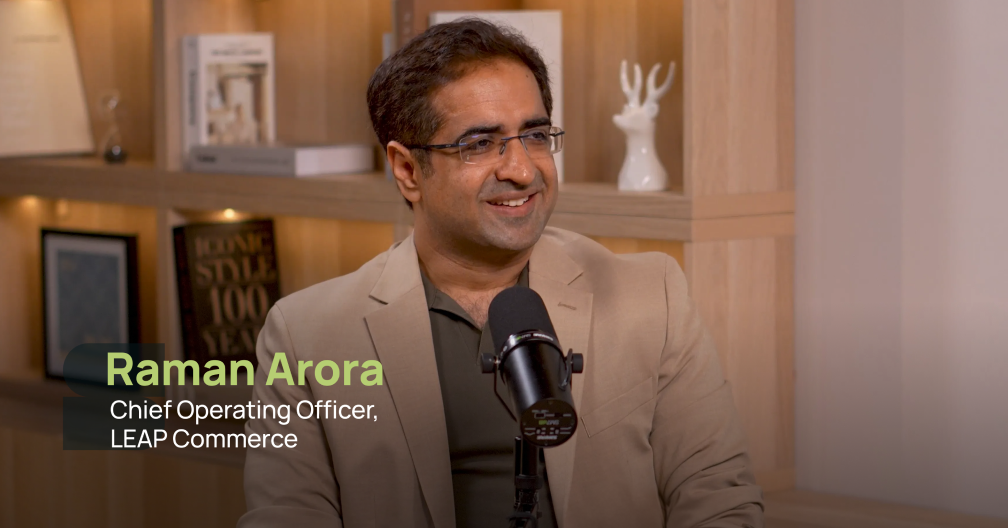
An editorial synthesis of insights from Raman Arora, Chief Operating Officer of Leap Commerce, in conversation with Anchanto’s CMO Charles Py.
Southeast Asia is one of the most complex commerce markets in the world. Each of its six major economies has its own consumer profile, shaped by age, income, religion, and language, according to a 2026 analysis from Lanmea Resources. That means brands operating here are effectively managing six separate markets, not one single audience.
To dive deeper into what’s actually happening on the ground, we sat down with Raman Arora, Chief Operating Officer of Leap Commerce, who’s spent nearly a decade navigating the SEA market and beyond.
Key Highlights
- Southeast Asia isn’t one market. It’s at least six, each with its own language, regulations, and consumer behavior, and cross-border e-commerce demands its own strategy on top of that.
- The consumer journey is blended, so structure should follow it, not fight it. Org charts and financial reporting should be blended too.
- Discounting works like debt. It buys short-term reach but erodes long-term brand value.
- The COO role now spans operations, data, and commercial strategy, driven by how fragmented and fast-moving the region is.
- AI’s real commercial upside lies at the discovery stage of commerce, where it can help enhance the shopping experience.
Why This Perspective Matters
Raman Arora has spent close to a decade building Leap Commerce, headquartered in Singapore. It started as an internal experiment inside Luxasia, the 40-year-old beauty and luxury distribution house. Since then, it’s grown into a full-service e-commerce enabler operating across eight markets in Asia, with Australia and India next in line. His tenure spans the earliest days of the industry. He watched order files move from spreadsheets to live platforms as Lazada and Shopee entered the region. And he navigated the year COVID compressed decades of digital growth into twelve months.
That vantage point, operator rather than observer, is what makes his take on cross-border e-commerce in Southeast Asia worth paying attention to.
Below are the highlights from a wide-ranging conversation, organized around four themes:
- Regional fragmentation
- The economics of discounting
- The changing shape of the COO role
- Where AI is genuinely useful, and where it’s just noise
1. Southeast Asia Is Not a Single Market: It’s At Least Six
Brands tend to make one mistake above all others when they enter the region: they see “600 million people” and treat Southeast Asia as one addressable block. It isn’t, and correcting that assumption is where Raman starts almost every conversation with a new brand.
“We are not a homogenous 600 million people block. We are Singapore, and Malaysia, and Indonesia, and Philippines, and Vietnam, and Thailand,” says Raman.
As he tells it, each of those countries has its own language, its own culture, and its own religion. Religion, in turn, shapes both the products a brand can sell and the regulatory environment it operates under.
Take Halal certification as an example. In Malaysia and Indonesia, it isn’t a “nice to have” for certain categories; it’s mandatory. A brand operating from outside the region often won’t know that nuance exists until it costs them.
The fragmentation runs deeper than culture, too. Marketplaces themselves are built country by country rather than as a single regional entity. Shopee Singapore, Shopee Indonesia, and Shopee Vietnam are run as distinct operations, not a shared shopfront. Purchasing power varies by GDP per capita, and commute times shape how people shop; Singapore’s short commutes mean less app browsing time than in Indonesia or Vietnam. Social commerce is just as uneven. Vietnam’s behavior here, in his words, doesn’t resemble anywhere else in the region.
For brands, the practical upshot is simple: treat market entry as six-plus distinct go-to-market strategies with six distinct regulators and consumer bases, not one campaign localized six times.
Leap Commerce’s own footprint reflects this same logic. Beyond the six core Southeast Asian markets, Leap runs a dedicated cross-border hub in Hong Kong and maintains a presence in Taiwan. Cross-border commerce, in other words, gets treated as its own discipline, not an extension of any single domestic market. Expansion into other countries like Australia and India follows the same principle. Each new market gets its own go-to-market approach, not a copy of what worked in Southeast Asia.
2. The Consumer Journey Has Stopped Being Linear, and That’s Reshaping Org Charts
Raman argues that the old debate, “does e-commerce belong to marketing, sales, or ops?”, is the wrong question to ask today. The consumer journey no longer moves in a straight line through any single function’s territory.
Picture a realistic modern path to purchase. A shopper sees a product in a physical store and photographs it. Maybe they ask an AI assistant, search Google, or watch a YouTube review to understand the features. Then they check a marketplace for pricing, and the brand’s own site for loyalty perks. They go back to the store and talk to a sales associate. All the while, they’re discussing it with family, all before deciding where, let alone whether, to buy.
According to Raman, “The journey for them to purchase is not a single journey, and it’s also not linear. They’ll be going from platform to platform: from digital world to the physical world, back to the digital world.”
Leap Commerce and Luxasia are built around that same concept. They run as one P&L, even though one team manages online and the other offline. Consumer CRM and data collection sit under Leap regardless of whether the touchpoint is physical or digital, because the customer relationship isn’t split just because the channel is.
The lesson for other organizations follows naturally: structure should follow the customer’s experience, not fight it. If the customer journey is blended, the org chart and financial reporting should be blended too.
3. Discounting Is Debt, Not a Strategy
Raman’s believes that discounting is a financial liability, not a growth lever.
“Discounts are equivalent to debt for a company, in the way that they set up the long-term vision,” claims Raman.
The habit traces back to how regional marketplaces built scale in the first place: largely by fronting consumer discounts to create a large enough audience. It worked, reach grew fast, but it also trained consumers to expect a sale is always around the corner. What began as a single “11.11” flagship sale day has splintered into a nearly continuous calendar: 9.9, 10.10, 12.12, payday campaigns, mid-month campaigns, category days. There’s rarely a wrong day to wait for a better price anymore.
The businesses doing it right, in his view, are the ones that resisted that gravity. SK-II is one example: Leap has scaled the brand significantly on marketplaces with essentially zero discounting. Lululemon’s more recent effort to hold pricing discipline is another he’s watching closely, even amid rising competition.
The broader point is that brands and enablers need to jointly figure out what value proposition exists beyond price. A business built solely on discount depth has no long-term moat, only a short-term traffic spike.
4. What “COO” Actually Means at a Digital Commerce Enabler
Raman’s title carries a wider mandate than the traditional operations brief; commercial strategy and data sit under him too. He doesn’t see this as scope creep so much as a natural consequence of operating in a market which is fragmented and fast-moving.
“I believe we’re in a space where there are problems to be fixed, wherever the problem is, be that operations, data, technology, or commercial, we get in and try to fix that particular problem,” says Raman.
Nearly a decade in, Leap Commerce still runs with a startup mentality: young, nimble, structured around removing friction wherever it appears rather than defending a fixed functional lane. In a region where consumer behavior, platform rules, and competitive dynamics shift by country and by year, he argues that posture isn’t optional.
5. On AI: Separate the Genuine Unlock From the Performance of Productivity
Raman’s take on AI is pragmatic for someone running a fast-moving digital commerce business, and it’s grounded in direct experience rather than hype-cycle enthusiasm.
Start with what he calls “token-maxing” your own life. He’s noticed a pattern among some AI power-users. They push their own output the way a model pushes out tokens, treating rest like something to avoid rather than something they need. Some are building tools, like a “second brain,” then a “third brain,” without asking what problem those tools actually solve. Using lots of tokens has become a badge of honor for some people, in his view, even when it doesn’t add real value.
“The true cost of AI is something we haven’t learned yet,” he notes.
He has a favorite analogy for the gap between building something and building something that scales: AI-assisted app-building, he says, is a lot like owning a home espresso machine. It makes everyone feel like a barista. But running a café, with sourcing, certification, seating, and logistics all in the mix, is an entirely different discipline than pulling one good shot at home. Vibe-coding an app for an audience of one isn’t the same exercise as building that same app for the world. The visible, easy part (the front end) is a small fraction of the invisible infrastructure, authentication, and data-architecture work required to actually scale it.
As for where the real commercial upside sits, Raman points to agentic commerce. Specifically, he means the discovery stage rather than transaction execution, which he sees as more solved already. There’s a nuance worth sitting with here too: every point of friction removed from a shopping journey is also a point of consent removed. He expects the pendulum to swing toward AI-driven autonomous purchasing before consumers push back. Eventually, they’ll reclaim explicit control over decisions that matter to them, like a preference for a white shirt over a system’s suggested brown one.
This is a snapshot of a much longer conversation. Raman also gets into his take on vibe-coding, the true cost of AI, and a near-future story about a coffee machine that thinks it knows better than you do.
Southeast Asia will keep rewarding the brands that build for its complexity rather than work around it: six markets, six regulators, and a customer journey that never sits still. That’s the exact problem Anchanto helps brands solve, with the order management, omnichannel fulfillment, and pricing tools to move fast across a fragmented region without losing control of any single market.