

Vietnam e-commerce has emerged as one of Southeast Asia’s most dynamic digital markets. It demonstrates remarkable resilience and adaptability in an increasingly connected global economy. The country presents exceptional opportunities for businesses seeking to establish or expand their digital presence in the region. Vietnam’s strategic location, progressive government policies under the National E-Commerce Development Master Plan for 2021-2025 [1], and rapidly evolving consumer behaviors have positioned it as a must-watch market for international and domestic e-commerce players alike.
In this comprehensive guide, we explore the Vietnam e-commerce ecosystem, examining market dynamics, emerging trends, platform landscapes, consumer behaviors, logistics challenges, and strategic approaches that define success in this vibrant and rapidly expanding digital economy.
Overview of Vietnam’s E-commerce Market
The Vietnam e-commerce market has experienced explosive growth in recent years, solidifying the country’s position as one of the fastest-growing digital economies in Southeast Asia. In 2024, the market surpassed $25 billion, representing a 20% year-over-year increase, according to a report by Google [2]. This remarkable growth trajectory shows no signs of slowing, with projections indicating the market could reach between $90 billion and $200 billion by 2030.
E-commerce now accounts for approximately 9% of Vietnam’s total retail sales [3], representing a significant shift in consumer purchasing behavior. More remarkably, the sector comprises over 60% of Vietnam’s entire digital economy [4], making it a critical driver of the country’s economic transformation.
How Vietnam Became a Fast-Growing E-commerce Hub in Southeast Asia
Vietnam’s transformation into an e-commerce powerhouse stems from a convergence of demographic, technological, and political factors. The country’s youthful demographic profile, with a median age under 32 [5], has proven instrumental in driving digital adoption. This tech-native generation views online shopping as a default option rather than an alternative.
Governmental Initiatives
Government initiatives have played an equally critical role. The National E-Commerce Development Master Plan for 2021-2025 established comprehensive frameworks and policies to enhance e-commerce activities. The National Digital Transformation Program aims to increase the digital economy’s contribution to overall GDP in the future.
Upgrades to Infrastructure
Infrastructure development has also been paramount. Internet penetration has reached approximately 84% of the population [6]. The ongoing rollout of 5G networks, now covering 3 million users [7], promises to further enhance connectivity and enable more sophisticated e-commerce applications.
Key Segments in Vietnam’s E-commerce Landscape
The e-commerce market in Vietnam encompasses diverse business models and product categories, each experiencing different growth trajectories and serving distinct consumer needs.
1. Business-to-Consumer (B2C) E-commerce
B2C e-commerce represents the dominant segment, accounting for approximately 74% of the total Vietnam e-commerce market in 2024 [8]. Major platforms have invested heavily in building trust through buyer protection programs, authentic seller verification, and streamlined return processes. The B2C segment recorded approximately $12.67 billion in revenue from registered e-commerce platforms in 2024 [9].
2. Business-to-Business (B2B) E-commerce
While B2B e-commerce in Vietnam currently represents a smaller market share, it demonstrates the highest growth potential with a projected compound annual growth rate of 22.1% through 2030 [10]. B2B platforms are facilitating connections between manufacturers, wholesalers, and retailers, streamlining previously complex offline processes. The B2B e-commerce in Vietnam sector benefits from reduced transaction costs, improved supply chain visibility, and access to broader supplier networks.
3. Product Category Performance
According to PCMI [11], Consumer electronics maintained the largest market share at 27% of Vietnam e-commerce in 2024, driven by high smartphone penetration. However, food and beverages is experiencing the fastest growth at a 28.4% CAGR, as quick-commerce models offering 30-60 minute delivery convert traditional purchases into online transactions. Fashion and apparel, beauty and personal care, and home and living products continue performing strongly across platforms.
Top E-commerce Platforms in Vietnam
Vietnam’s e-commerce ecosystem features intense competition among international giants, regional players, and homegrown platforms. Understanding which is the best e-commerce platform in Vietnam depends on specific business needs, target demographics, and product categories.
Shopee Vietnam: Shopee dominates as the market leader, commanding approximately 65% of gross merchandise value [12] among major platforms in 2024, equivalent to around $10.4 billion. The platform’s success stems from its mobile-first design philosophy, gamification elements, and comprehensive free shipping programs. Shopee’s integration of entertainment and commerce, termed “shoppertainment,” has proven particularly effective with Vietnamese consumers.
TikTok Shop Vietnam: TikTok Shop has emerged as the fastest-growing e-commerce force, capturing 28% of market share (approximately $4.5 billion GMV) in 2024 and experiencing an astonishing 99% year-over-year growth. Launched in April 2022, the platform leverages TikTok’s massive social media presence with over 67 million users to create unique shopping experiences through livestream commerce and video content.
Lazada Vietnam: Backed by Alibaba Group, Lazada offers sophisticated logistics infrastructure and advanced seller tools. Despite facing increased competition, Lazada maintained approximately 6% market share ($1 billion GMV) in 2024, focusing on quality service and brand partnerships. The platform’s integration with Alibaba’s ecosystem provides access to international supply chains and cutting-edge technologies.
Tiki Vietnam: As Vietnam’s most successful homegrown e-commerce platform, Tiki has built a strong reputation for customer service excellence and product quality assurance. Founded in 2010, Tiki controls its end-to-end supply chain and boasts the highest customer satisfaction rates among Vietnamese platforms.
Sendo Vietnam: Sendo operates as a multi-vendor marketplace with a particular focus on reaching beyond major urban centers. Founded in 2012, Sendo has carved out a niche by serving secondary cities and rural areas, with approximately two-thirds of orders coming from outside Hanoi and Ho Chi Minh City [13].
Growth of Social Commerce and Livestream Shopping in Vietnam
Social commerce represents one of the most transformative trends reshaping Vietnam e-commerce, with the sector experiencing explosive growth that fundamentally changes how Vietnamese consumers discover and purchase products.
According to PCMI [14], Vietnam’s social commerce market reached $3.99 billion in 2024 and is projected to grow by 25.4% annually, reaching $5 billion in 2025 and potentially $10.21 billion by 2030. With 72.70 million social media users representing 73.3% of Vietnam’s population, these platforms provide unprecedented reach and engagement opportunities.
Livestream shopping has emerged as a defining characteristic of Vietnamese e-commerce. In 2024, approximately 2.5 million livestream shopping sessions occurred monthly, involving over 50,000 sellers. According to recent research, approximately 95% of online shoppers made purchases through livestreaming in Q1 2024, with viewers dedicating an average of 13 hours per week to watching livestreams.
The psychological factors driving livestream shopping success include the fear of missing out (FOMO) created by limited-time offers, social proof from watching others purchase in real-time, direct engagement with sellers, and entertainment value that makes shopping enjoyable rather than transactional.
Types of Online Business in Vietnam
Vietnam’s e-commerce ecosystem supports diverse business models, each offering unique opportunities for entrepreneurs and established companies.
Marketplace sellers represent the most accessible entry point, offering immediate access to massive customer bases through platforms like Shopee, Lazada, and TikTok Shop without requiring significant upfront investment in platform development.
Social commerce entrepreneurs build successful businesses primarily through social media channels, using Facebook Pages, Instagram accounts, or TikTok profiles to engage directly with customers. This model emphasizes authentic relationships and community building over traditional infrastructure.
Direct-to-consumer (DTC) brands establish their own e-commerce websites, maintaining complete control over customer experience and data. While requiring greater technical expertise and marketing investment, this approach offers higher profit margins and freedom from platform commissions.
Cross-border e-commerce businesses leverage Vietnam’s strategic location and participation in multiple free trade agreements to facilitate international trade. Some source products internationally for Vietnamese consumers, while others export Vietnamese products to global markets.
E-commerce Penetration in Rural Regions of Vietnam
While urban areas like Hanoi and Ho Chi Minh City dominate Vietnam e-commerce activity, accounting for approximately 75% of orders, rural regions represent significant untapped potential as infrastructure and digital literacy improve.
Rural e-commerce adoption has accelerated, driven by improving internet connectivity, increasing smartphone penetration, and platform efforts to expand delivery networks. Government initiatives to improve rural digital infrastructure, including fiber-optic network expansion programs, promise to narrow connectivity gaps by 2028.
Despite progress, several obstacles constrain rural growth. Intermittent broadband reliability, lack of standardized address systems, limited cold-chain logistics infrastructure, and continued dominance of cash-on-delivery (85% of digital purchases in some rural regions) create operational challenges. However, these markets offer compelling opportunities for businesses willing to adapt strategies. Social commerce proves particularly effective where trust plays a paramount role in purchase decisions.
Logistics and Last-Mile Delivery in Vietnam’s E-commerce
Efficient logistics infrastructure forms the backbone of successful Vietnam e-commerce operations, yet the sector faces significant challenges impacting delivery speed, reliability, and cost-effectiveness.
Vietnam’s e-commerce logistics market, valued at approximately $1.62 billion in 2024, is projected to reach $2.53 billion by 2030. The ecosystem comprises traditional postal services like Vietnam Post, Viettel Post, and EMS, along with technology-driven startups like Ninja Van, Giao Hang Nhanh (GHN), and Giao Hang Tiet Kiem (GHTK).
Last-mile delivery accounts for up to 40% of total logistics costs, representing the most expensive and complex fulfillment segment. Urban congestion in major cities, infrastructure limitations in rural areas, cash-on-delivery complexity, and high volumes of small orders create profitability challenges.
The logistics sector is innovating rapidly to improve efficiency. Providers are implementing urban consolidation centers in tier-2 cities, reducing delivery times by up to 40%. Advanced route optimization algorithms help delivery personnel navigate efficiently, while expanding parcel locker networks provide convenient pickup options. Investment in cold-chain infrastructure is gradually expanding, crucial for realizing projected growth in food and beverage e-commerce.
For businesses seeking to establish successful e-commerce operations, leveraging advanced order management systems becomes essential for navigating Vietnam’s complex logistics landscape.
Challenges in Vietnam’s E-commerce Market
While Vietnam e-commerce demonstrates impressive growth, businesses must navigate several significant challenges to achieve sustainable success.
Infrastructure disparities persist between major cities and rural regions, with intermittent internet connectivity and transportation infrastructure ranked 55th globally [15]. These disparities force difficult decisions about geographic prioritization and resource allocation.
Logistics complexity and costs account for approximately 20% of total product prices, significantly impacting profitability. The concentration of orders in major cities intensifies competition while serving rural areas remains economically challenging.
Counterfeit and quality concerns remain prevalent on major platforms, creating consumer trust issues. Platforms are investing in seller verification programs, but businesses that establish strong reputations for authentic products gain significant competitive advantages.
High customer acquisition costs driven by fierce platform competition have reached unsustainable levels. Capturing just 1% of the Vietnam e-commerce market demands approximately $6 million in annual media spending [16], well beyond most SMEs’ reach.
Tips to Succeed in Vietnam’s E-commerce Industry
Success in Vietnam’s competitive e-commerce landscape requires strategic planning, deep local market understanding, and operational excellence. Consider how to start e-commerce business operations with these proven strategies.
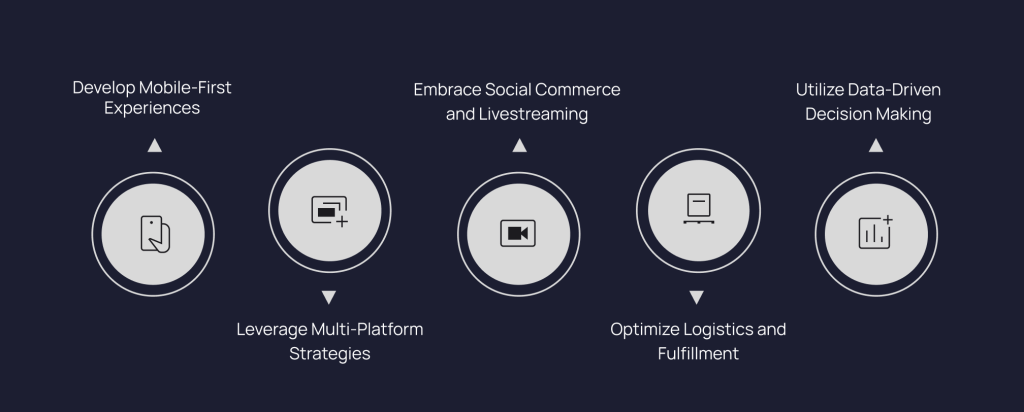
1. Develop Mobile-First Experiences
With 96% of Vietnamese consumers using smartphones to shop online and mobile devices accounting for 72% of transactions in 2024 [17], mobile-first design is essential. Prioritize fast loading times, intuitive navigation, streamlined checkout processes, and integration with popular local payment methods.
2. Leverage Multi-Platform Strategies
Successful businesses develop sophisticated multi-channel strategies leveraging the unique strengths of different marketplaces. Consider the best e-commerce platform in Vietnam for your specific products. Shopee may excel for mass-market products, while TikTok Shop proves more effective for fashion and beauty items where visual content drives purchasing.
3. Embrace Social Commerce and Livestreaming
Given Vietnamese consumer preferences for social-driven shopping, develop capabilities in social commerce and livestream shopping. Effective livestreaming involves planning engaging content, training charismatic presenters, offering exclusive promotions, and responding to viewer questions in real-time. Partner with influencers whose audiences align with your target customers.
4. Optimize Logistics and Fulfillment
Partner with reliable logistics providers who understand Vietnam’s geographical challenges. Implement comprehensive parcel tracking systems providing customers with real-time visibility while enabling proactive exception management. Consider warehousing strategies that balance cost efficiency with delivery speed requirements.
5. Utilize Data-Driven Decision Making
Leverage analytics to understand customer behavior patterns, optimize marketing spend, and identify growth opportunities. Implement tracking for key performance indicators, including customer acquisition cost, conversion rates, and return rates. A/B testing helps identify what resonates with Vietnamese consumers.
Future of E-commerce in Vietnam
Vietnam e-commerce stands at an inflection point, with several emerging trends poised to reshape the landscape and create new opportunities for well-positioned businesses.
1. Expansion Beyond Urban Centers
As internet infrastructure continues improving in rural areas through government-backed fiber programs, Vietnam e-commerce will expand beyond its current urban concentration. Platforms and sellers developing expertise serving secondary cities and rural markets before competitors can establish defensible positions.
2. Maturation of Social Commerce
Social commerce will continue evolving from rapid growth toward maturation, with platforms refining features and boundaries between entertainment, social interaction, and commerce becoming increasingly blurred. Live commerce is expected to account for growing shares of platform revenue, potentially reaching 20-30% of total GMV for social-first platforms.
3. Cross-Border E-commerce Growth
The future of e-commerce in Vietnam includes significant expansion of cross-border activity as free trade agreements like CPTPP and RCEP reduce tariffs and simplify customs procedures. Cross-border imports grew 43% in 2024 to 324.1 million items valued at $568 million [18]. Vietnamese businesses will simultaneously expand into regional and global markets, leveraging manufacturing strengths in textiles, footwear, and agricultural products.
Understanding e-commerce market size by country provides valuable context for strategic decision-making across Southeast Asia, while enterprise integrations enable seamless connectivity across platforms and systems.
4. Regulatory Evolution
The Vietnamese government continues developing specialized legal frameworks for e-commerce, with 2025 initiatives focusing on creating stable, transparent regulatory environments [19]. Consumer protection laws, data privacy regulations, and taxation policies will evolve to address challenges emerging from rapid market growth.
Ready to capitalize on Vietnam’s booming e-commerce market? Discover how Anchanto’s SaaS solutions can help you navigate Vietnam’s complex multi-platform landscape.
FAQs
1. Which are the top e-commerce platforms in Vietnam?
The leading platforms in Vietnam e-commerce include Shopee Vietnam, followed by the rapidly growing TikTok Shop. Other significant players include Lazada Vietnam, Tiki (Vietnam’s leading homegrown platform), and Sendo.
2. How popular is cross-border e-commerce in Vietnam?
Cross-border e-commerce is experiencing rapid growth in Vietnam e-commerce, with imports reaching 324.1 million items valued at $568 million in 2024, representing 43% year-over-year growth. Vietnamese consumers increasingly purchase from international sellers for access to authentic foreign brands, unique products unavailable domestically, and sometimes more competitive pricing.
3. What are the most purchased product categories in Vietnam’s e-commerce?
Consumer electronics dominates the e-commerce market in Vietnam with 27% market share, driven by high smartphone adoption and consumer appetite for technology. However, food and beverages represents the fastest-growing category with a 28.4% CAGR as quick-commerce models enable 30-60 minute delivery. Fashion and apparel remains consistently popular, particularly on social commerce and livestream platforms.
4. How do digital wallets and COD (Cash on Delivery) impact Vietnam’s e-commerce?
Digital payment adoption is growing rapidly in Vietnam e-commerce, with mobile wallets like MoMo, ZaloPay, VNPay, and ShopeePay gaining substantial traction among younger, urban consumers.
5. When does Vietnam see peak e-commerce sales?
Vietnam experiences peak e-commerce activity during several key shopping periods throughout the year. The most significant events include Singles Day (November 11) and 12.12, which generate massive platform promotions and livestream shopping marathons.
References:
[2] Economysea.withgoogle.com – From Digital Decade to AI Reality: Accelerating the future in ASEAN
[3] Vneconomy.vn – E-commerce exceeding $25 bln in 2024
[4] Vneconomy.vn – Vietnam poised to become an e-commerce dragon in Southeast Asia
[5] Worldpopulationreview.com – Vietnam
[6] Data.worldbank.org – Individuals using the Internet (% of population) – Viet Nam
[7] Vnexpress.net – Vietnam’s 5G network reaches 3 million users in rapid urban expansion
[9] Vneconomy.vn – Vietnam e-commerce revenue surpasses $12.6 bln in 2024
[11] Paymentscmi.com – Breaking Down Vietnam’s E-Commerce Market
[12] Vietnamplus.vn – Vietnamese consumers spend 16 billion USD on online shopping in 2024
[13] Kr-asia.com – How Vietnamese e-commerce platform Sendo captures consumers outside big cities
[14] Paymentscmi.com – Breaking Down Vietnam’s E-Commerce Market
[16] Vnexpress.net – Vietnam’s e-commerce explodes in 2024
[17] Paymentscmi.com – Breaking Down Vietnam’s E-Commerce Market
[18] Vnexpress.net – Vietnam’s e-commerce explodes in 2024
[19] Opengovasia.com – Vietnam: Draft Law to Strengthen E-commerce Regulation