

1. Overview of the E-commerce Market in France
France is the third-largest e-commerce market in Europe, behind only the UK and Germany. In 2025, the French retail e-commerce market reached $88.8 billion (€75.3 billion), with forecasts showing a 10.65% CAGR through 2030, hitting $128.4 billion (€108.9 billion) by the end of the decade [1].
This growth is fueled by stable digital infrastructure, a mobile-first shopping culture, and rising expectations for convenience, value, and speed.
Key Market Highlights [2]
- Total online sales in 2024: $206.7 billion (€175.3 billion), up 9.6% from 2023
- Product sales: $78.9 billion (€66.9 billion), recovering after post-COVID slowdowns
- Average order value: $80 (€68), steady due to low-cost offerings and reduced inflation
- Annual spend per buyer: Around $4,971 (€4,216), with over 50 transactions per year
- Share of total retail: E-commerce now accounts for approximately 11% of all retail sales in France
2. What’s Fueling E-commerce Growth in France?
Several factors are contributing to France’s steady e-commerce expansion. These include:
High Digital Penetration: France has over 50 million active online shoppers [3], with 94% internet penetration [4] and one of the strongest mobile commerce cultures in Europe.
Diverse Purchase Patterns: Shoppers increasingly split purchases between domestic platforms and cross-border sellers. Luxury, FMCG, tech, and apparel remain dominant categories.
Consumer Trust in Online Shopping: French consumers are highly privacy-aware, but they continue to buy online due to robust consumer protection laws and secure payment methods.
Government Support and Infrastructure: Public initiatives like France Num encourage digital transformation for small businesses. Meanwhile, improved broadband coverage and warehouse infrastructure support faster delivery.
Innovations in Payment: Widespread adoption of Buy Now Pay Later (BNPL) and secure digital wallets is reshaping checkout experiences, particularly among Gen Z and millennials.
Rural and Suburban Demand: Improved connectivity and logistics networks are driving online retail adoption beyond major cities.
3. E-commerce Consumer Behavior in France
Online shopping is part of daily life for most French consumers. With over 43 million online shoppers, accounting for more than 80% of the internet population in 2024 [5], which shows people prefer convenience, enjoy the online shopping experience, and have trust in e-commerce.
Let’s have a look at different behavioral aspects of French online shoppers [5]:
a. Who is Buying Online?
- 81% of total internet users shop online in France.
- Out of the total French male population, 82.8% buy online, and out of the female population, 80.1% purchased goods online.
- 73% of people aged 65+ made at least one online purchase in the last year.

b. Where Do They Discover Products?
- 37% discover new products through word of mouth (especially among women).
- 34% discovered through online marketplaces.
- 27% use Amazon’s “Recommended” section.
- 22% of 18–25-year-olds rely on social media ads.
- 18% come from Google Ads or search engine results.
c. How Do They Search?
- 47% start their product search on Amazon.
- 28% begin with search engines like Google.
d. What Do They Expect from E-commerce Stores?
User experience is non-negotiable. French shoppers leave if they don’t find what they need quickly. Here are some statistics to understand customer behaviour and their expectations:
- 56% abandon carts if product information is missing.
- 47% consider image and description quality among the top 3 buying factors.
- 60% actively research product quality before purchasing.
- 41% care about customer support.
- 44% are willing to pay more for brands they trust.
- 25% check for environmental certifications.
e. How Do They Prefer Product Delivery?
While home delivery remains dominant, consumers are open to alternatives if it means speed and convenience.
Top parcel carriers in the country include:
- La Poste handles 68% of deliveries.
- Chronopost and Mondial Relay follow with 38% and 29% respectively.
Delivery preferences include:
- Click and collect (which is now mainstream), especially in urban areas.
- 20% used express delivery at least once in the past 3 months.
f. How Do They Pay?
Card payments lead, but digital wallets and installments are gaining ground. Here are the different preferred payment methods based on usage:
- Card: 54%
- Digital wallets (PayPal, Apple Pay): 21%
- Bank transfer: 14%
- Cash: 7%
- Other: 5%

g. What About Trust in Foreign Sites?
French buyers are cautious with international sellers. Around 60% say they prefer buying from domestic websites, citing concerns over returns, delivery time, and customer support.
This creates an advantage for local sellers and foreign brands that localize France e-commerce operations, customer service, and compliance.
4. Top 10 E-commerce Platforms and Marketplaces in France
The French marketplace mix spans generalists, specialists, and high-growth circular platforms. Let’s look at the most popular e-commerce websites in France:
1. Amazon: Amazon is the undisputed leader in France’s e-commerce market, drawing over 35 million monthly unique visitors [4]. It dominates across almost every category, with shoppers trusting its fast delivery, competitive pricing, and expansive assortment.
2. Cdiscount: Cdiscount is France’s second-largest marketplace with over 20 million monthly users and a nearly 9% share of national e-commerce [4]. It is a popular shopping destination to buy electronics, home appliances, fashion, toys, and sports items. Cdiscount is known for strong domestic roots and value-driven shopping.
3. Fnac: Fnac is one of the most trusted French retail brands, historically strong in books and entertainment. Its digital marketplace leverages this legacy and brings an audience that values content-rich listings and product credibility.
4. Darty: Part of the Fnac Darty group, Darty sells mostly large appliances, TVs, computing, audio equipment, and smartphones. It is known for excellent after-sales service and product expertise. It draws over 11 million monthly visits, especially from shoppers looking for reliability and support [4].
5. Vinted: Vinted leads the circular fashion market (clothing, accessories, shoes) in France e-commerce and is the go-to destination for secondhand buyers and Gen Z shoppers. Its peer-to-peer model and mobile-first design drive massive engagement.
6. Veepee: Veepee is France’s largest flash sales platform, designed for limited-time offers that create urgency and high conversion. It is perfect for fast sell-through of seasonal or excess inventory, and you can browse through products in fashion, beauty, lifestyle, and home goods.
7. Back Market: Back Market leads the refurbished electronics category in France and Europe. With a focus on sustainability, warranties, and certified sellers, it has become the go-to for affordable, eco-conscious tech.
8. ManoMano: Founded in France, ManoMano is now a top marketplace for DIY enthusiasts and homeowners looking for tools, materials, and gardening products. It attracts more than 16 million monthly visitors, driven by project-based navigation and product guidance [4].
9. La Redoute: La Redoute is a historic French lifestyle brand known for blending fashion and home décor. Its marketplace is style-led and trusted by households shopping for apparel and home furnishings.
10. Decathlon: Decathlon is the largest sports retailer in Europe, with over 20 million monthly visitors in France. Its marketplace provides instant access to a loyal, active buyer base.
5. Logistics and Last-Mile Delivery in France
The French last-mile logistics ecosystem is evolving fast. Fueled by e-commerce growth and rising delivery expectations, the market is shifting toward faster, cleaner, and more specialized delivery solutions.
a. Key Players Dominating the Last-Mile Network
In France, the delivery market is moderately concentrated. Five major carriers handle about 60% of the parcel volume [6]:
1. Colissimo (La Poste): National postal carrier with the largest residential delivery network
2. Chronopost: Express shipping specialist under La Poste Group, known for next-day delivery
3. DPD France: European parcel giant offering carbon-neutral deliveries
4. Mondial Relay: Popular for parcel locker and pickup-point deliveries
5. DHL and FedEx: Focused on premium cross-border and express segments
Other notable operators include UPS, GLS, Relais Colis, and XPO Logistics. Each player focuses on a mix of speed, reach, and convenience, often competing on price, lockers, or last-mile tech.
b. Regional Delivery Hotspots
A majority of the parcel movement in France is concentrated around urban and logistics-heavy zones. These areas drive demand for faster delivery, tighter SLAs, and greater carrier density. The most common hotspots in France are:
- Île-de-France (Paris region) leads all other regions in parcel volume due to dense population and high online retail activity
- Lyon, Marseille, Lille, and Toulouse are also major e-commerce zones
- E-commerce hubs near fulfillment centers (e.g., Orléans, Rouen) see higher last-mile concentration
B2C is the largest segment of the last-mile network in France [7], but niche verticals like cold chain logistics (for food or pharma), high-value delivery, and locker-based fulfillment are rapidly gaining ground.
c. The Expanding Role of 3PLs in France
Third-party logistics (3PL) providers are essential partners for e-commerce brands looking to scale in France without managing their own infrastructure. They handle everything from warehousing and fulfillment to last-mile delivery coordination.
For fast-growing DTC brands or international sellers entering the French market, 3PLs offer:
- Localized fulfillment close to urban centres like Paris, Lyon, and Marseille
- Multi-carrier integrations with Colissimo, DPD, Chronopost, and others
- Customizable delivery experiences, including next-day, locker, and pickup point options
- Returns management, which is especially important in fashion and electronics
Leading French 3PLs like L4 Logistics, Cubyn, Wing, SupplyWeb, and Staci utilize warehouse automation, real-time tracking, and integrations with Shopify, Prestashop, and marketplaces like Amazon and Cdiscount.
6. Regulations and Compliance in French E-Commerce
France applies some of the strictest e-commerce regulations in Europe. Whether you’re a domestic brand or a cross-border seller, meeting the below compliances helps you operate smoothly and avoid hefty penalties.

a. GDPR and Data Protection
France strictly enforces the EU’s General Data Protection Regulation (GDPR), which applies to any business handling the personal data of EU residents. This includes names, emails, IP addresses, and purchase history.
Non-compliance can lead to fines of up to $23.6 million (€20 million) or 4% of global revenue, whichever is higher [8]. Hence, e-commerce companies must:
- Appoint a Data Protection Officer (DPO) if processing sensitive data or large-scale information
- Obtain explicit user consent before collecting data
- Allow users to access, correct, and delete their data
- Clearly outline privacy terms and cookie usage
b. Digital Services Act (DSA)
The Digital Services Act (DSA) came into force across the EU in 2023, with full enforcement in 2024 [9]. It affects marketplaces, platforms, and any site that hosts or recommends content.
Under the DSA, online sellers and platforms must:
- Clearly identify third-party sellers and display their contact details
- Actively moderate illegal or harmful content
- Report moderation actions and algorithms used for recommendations
- Provide transparency around advertising and data use
Platforms like Amazon, Cdiscount, and Vinted must comply as Very Large Online Platforms (VLOPs) under EU law. For sellers, this means your product listings and policies are now under closer platform scrutiny.
c. European Accessibility Act (EAA)
From June 28, 2025, all digital services across the EU must be accessible to people with disabilities under the European Accessibility Act (EAA) [10].
E-commerce websites and apps will need to:
- Ensure screen reader compatibility
- Provide clear navigation and keyboard accessibility
- Offer text alternatives for images and multimedia content
- Avoid content that relies solely on color or visual cues
This impacts product pages, checkout flows, customer support interfaces, and mobile apps. Accessibility audits and fixes should begin now if you plan to serve EU users to ensure inclusivity and compliance.
d. VAT and E-Invoicing
VAT rules in France follow the EU’s digital tax structure. For cross-border sellers:
- Digital services are taxed based on the buyer’s location, not the seller’s
- Sellers must apply French VAT (currently 20%) if selling to French consumers
- Platforms like Amazon often handle this via OSS (One-Stop Shop) registration
From September 2026 onwards, France is set to roll out mandatory B2B e-invoicing and e-reporting, beginning with large companies and gradually including SMEs [11].
e. Product Safety and E-Commerce Reforms
France holds online platforms increasingly accountable for the safety of products sold through their channels. Key developments include:
- Platforms must remove unsafe or non-compliant products quickly after notification
- For non-EU sellers, a legal representative in the EU is required to list certain goods (especially electronics, toys, and cosmetics)
- The EU’s Market Surveillance Regulation mandates traceability and documentation for sellers of high-risk goods
These rules apply whether you sell directly via your website or through third-party platforms. Failure to meet safety and labeling standards can lead to blocked listings and seizure by customs.
7. Challenges for Businesses in the French E-Commerce Market
Doing e-commerce in France is highly lucrative, but scaling here poses some challenges as described below:
a. Fragmented Market Behavior
Despite its digital maturity, France remains a fragmented retail environment, with consumers split between marketplaces, DTC websites, mobile apps, and social commerce. Shopping habits vary sharply by region, age, and channel preference, which complicates performance tracking and attribution.
b. Rising Data Privacy Expectations
French consumers are among the most privacy-conscious in Europe. Beyond GDPR, users expect brands to minimize tracking, offer clear consent choices, and avoid over-personalization. Even if a website follows all legal rules, users may still push back if they feel too much of their data is being collected or if it’s unclear how their data is being used.
This creates a tightrope for France’s e-commerce businesses, balancing personalization with privacy. Clear cookie banners, opt-outs, and respectful frequency in email or remarketing campaigns matter more here than in some other markets.
c. Cybersecurity and Fraud Risks
As e-commerce volumes grow, so do cybersecurity threats. Phishing, payment fraud, and account takeovers remain top concerns. France has introduced stricter controls on Strong Customer Authentication (SCA), but merchants still need to:
- Use 3D Secure for payments
- Implement fraud prevention tools with behavioral analytics
- Monitor for fake listings or unauthorized sellers on marketplaces
Even a single breach or data leak can damage brand trust, especially among first-time buyers.
d. Varying Digital Literacy
While internet penetration is high, digital literacy is not consistent across all demographics. Older users or residents in rural areas may struggle with mobile-first websites, complex checkout flows, or language barriers when it comes to global storefronts.
8. Opportunities for 3PLs, Retailers and Brands
The Franch 3PL market is expanding steadily. Businesses that align with rising demands like faster delivery, sustainability, and reverse‑logistics, stand to gain. The following are key areas of opportunity:
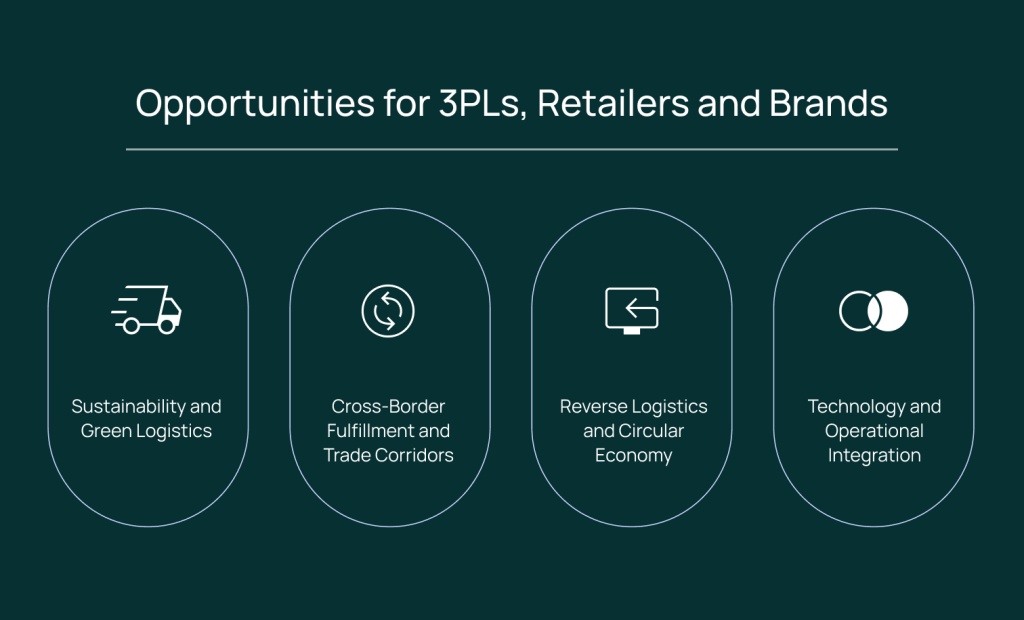
a. Sustainability and Green Logistics
Around 70% of French e‑shoppers prefer retailers that offer eco‑friendly delivery options [12].
3PLs can invest in electric fleets, micro‑hubs, cargo bikes, or parcel lockers in dense urban areas. Brands that offer low‑emission delivery often earn loyalty with eco‑aware consumers.
b. Cross‑Border Fulfillment and Trade Corridors
Post‑Brexit trade routes and EU customs digitization (e.g., ELO system) are creating faster, cheaper options for cross‑border shipping through France.
Cities like Lille and Calais are hubs for goods moving to Benelux or the UK; warehouses there or near ports can cut lead time and customs delays. Retailers that locate inventory in these zones gain a competitive edge.
c. Reverse Logistics and Circular Economy
The resale economy in France is projected to hit €14 billion by 2030, driving the need for efficient return inspection, refurbishment, and resale handling [13].
3PLs and brands can set up specialized returns facilities or partner with refurbishers to generate secondary revenue while reducing waste.
d. Technology and Operational Integration
Hybrid logistics models, combining owned automation hubs with subcontracted transport capacity, are scaling fastest.
Digital tools for inventory visibility, route optimization, and demand forecasting help minimize delays, reduce costs, and improve customer satisfaction.
9. Tips to Succeed in France’s E-Commerce Market
Adapting well to the French e-commerce market means balancing trust, localization, and efficiency. These tips will help you launch or scale smarter:
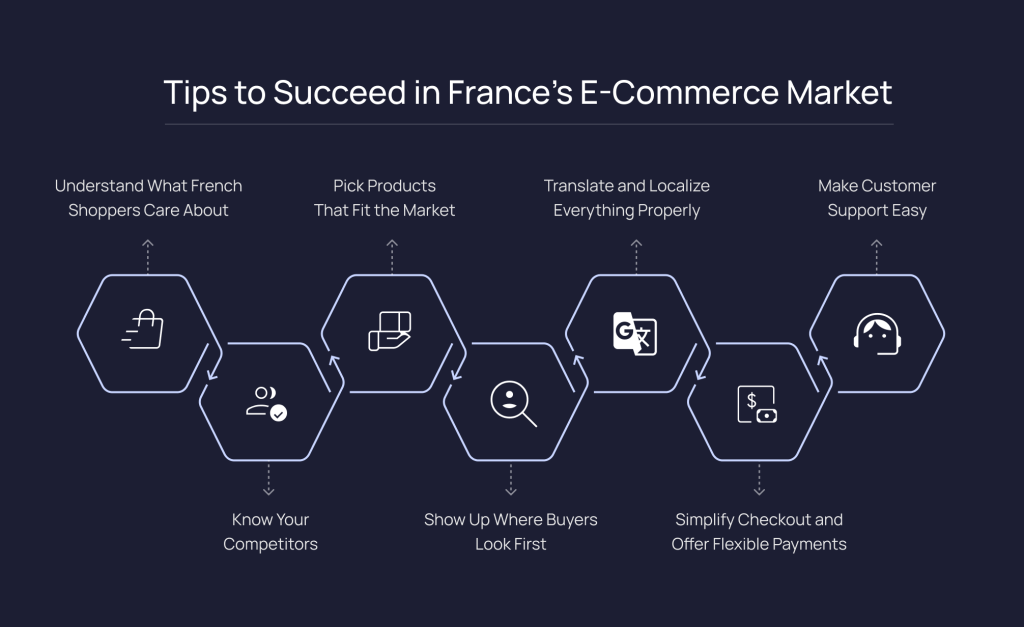
a. Understand What French Shoppers Care About
French buyers want clear information, fair pricing, and reliable service. Most prefer to see the total price upfront, including taxes. Many still pay with cards like Carte Bancaire or use local e-wallets. They read product pages closely and expect detailed specifications and high-res photos. Ensuring you meet these requirements will help you get noticed and gain customer loyalty.
b. Know Your Competitors
There are thousands of sellers on marketplaces like Amazon France, Cdiscount, and Fnac. Study their pricing, listings, delivery terms, and product reviews. Learn what makes their products and offers attractive. Tools like SimilarWeb, Keepa, or marketplace search bars can help you spot what’s working. Digital Shelf analytics can provide a clearer picture of your competitor’s performance compared to yours.
c. Pick Products That Fit the Market
Popular categories in France include fashion, beauty, books, small electronics, and second-hand goods. Items with a strong sustainability angle or local relevance often do well. For example, refurbished tech or eco-friendly home goods are seeing more traction in urban areas.
d. Show Up Where Buyers Look First
Many French buyers search directly on Amazon or use Google Shopping. Optimize your listings for both types of platforms. Use local keywords, list in the right categories, and keep your stock updated. Visibility on these platforms often matters more than just running ads.
e. Translate and Localize Everything Properly
Don’t rely on machine translation. Invest in writing your listings, ads, and website copy in proper French. This includes using the right terms, tone, and units (like cm instead of inches). A well-written product page builds more trust than any offer.
f. Simplify Checkout and Offer Flexible Payments
French shoppers abandon carts when checkout is slow or unclear. Keep it short, show shipping costs early, and offer trusted payment options. Split payments (like PayPal 4X or Alma) are becoming more common, especially for items over $100. Show that option upfront.
g. Make Customer Support Easy
A majority of French customers expect to get help by phone or email. And some still prefer speaking with a real person. Your help desk should be in French, with clear answers and return instructions. Showing good service builds long-term trust, especially if you’re a new brand in the market.
10. Future Outlook of the French E-commerce Market
France’s e-commerce sector is moving fast. From platform innovation to customer preferences, multiple shifts are reshaping how businesses operate and grow in the market.
Projected growth: The French e-commerce market is expected to hit $128.4 billion (€108.9 billion) by 2030, growing at a 10.65% CAGR from 2025 [1]. Growth will come from deeper digital adoption, faster mobile shopping, and improved broadband access. To stay competitive, businesses must invest in flexible and scalable digital infrastructure.
AI integration: Backed by machine learning and analytics, AI tools will help manage inventory, automate service, and optimize customer journeys. The French AI market in retail could reach €25 billion by 2031, pushing brands to adopt AI systems that improve ROI and business efficiency [14].
AR/VR: About 58% of European consumers expressed interest in using AR for online shopping in the countries like UK, France and Germany [15]. and by 2030, 76.6% of French consumers are expected to use AR or VR (Augmented Reality or Virtual Reality) [16]. These technologies will power virtual try-ons and immersive storefronts that reduce returns and increase engagement. Brands in fashion, home décor, and eyewear stand to benefit most by adding these tools early.
Blockchain: France’s blockchain market could reach $125.3 million (€106 million) by 2030, growing at 88.4% CAGR [17]. As cyber risks rise, blockchain adoption will help e-commerce businesses ensure supply chain transparency, payment security, and regulatory compliance. This will become especially relevant for cross-border sellers and luxury retailers verifying authenticity.
IoT/5G: The 5G IoT(Internet of Things) market in France is forecasted to grow from $490.6 million in 2024 to $5.68 billion (€4.81 billion) by 2030 [18]. Retailers and 3PLs using real-time tracking, smart sensors, and predictive maintenance will gain speed and accuracy across warehouses and last-mile delivery. This gives a major advantage in reducing delays and handling peak demand.
Sustainability: Eco-conscious buying will grow, especially as global cross-border e-commerce hits $5.6 trillion by 2030 [19]. In France, shoppers prefer brands with reusable packaging, ethical sourcing, and carbon-neutral shipping. Businesses must integrate sustainability into operations to remain compliant and win long-term trust.
Voice/smart-TV commerce: Voice shopping in France is expected to grow to $4.32 billion by 2030 [20], powered by rising smart device usage. As more households adopt voice assistants and smart TVs, brands that optimize for voice search will reach more customers in casual, hands-free moments.
EU AI Act: The EU AI Act will be fully applicable from August 2026 [21], requiring businesses to assess all high-risk AI systems. So, retailers must ensure transparency, fairness, and compliance in how they use AI for personalization, pricing, or automation. Early audits and documentation will reduce risk and build consumer trust.
BNPL: The BNPL (Buy Now Pay Later) market in France is expected to reach $42.17 billion by 2030, growing at 16.09% CAGR from 2025 [22]. Flexible payment models will boost order value, especially among younger shoppers. But with regulation tightening, businesses must choose BNPL partners that align with responsible lending practices.
Cross-border: France’s cross-border logistics market is forecast to grow to $13.6 billion by 2030, as global trade accelerates and AI logistics tools mature [23]. Retailers can boost revenue by streamlining customs, delivery, and returns for international buyers, especially in high-value categories like fashion, electronics, and luxury.
11. How Anchanto Helps Businesses Win in France
Expanding your e-commerce footprint in France means navigating multiple marketplaces, fulfillment partners, customer expectations, and real-time inventory, all while keeping costs under control. Anchanto brings all of that under one roof.
The Order Management System centralises orders, syncs inventory, and automates routing across channels. The Warehouse Management System streamlines B2C and B2B fulfilment with real-time tracking and efficient stock handling. And Digital Shelf Analytics lets you monitor search performance, pricing, availability, and content quality to stay competitive.
It gives you a single source of truth across orders, inventory, and catalog data. Whether you’re selling on Cdiscount, Amazon France, or your own storefront, the system syncs everything in real time. Orders are auto-routed to the right warehouse or store, bundled SKUs are tracked accurately, and you can cross-list products across channels without duplicating effort.
Designed for enterprise scale, Anchanto adapts to your current processes and lets you build smarter ones. So you can go from patchwork tools to a fully integrated order and inventory backbone built for growth.
FAQs
1. How big is the e-commerce market in France in 2025?
France’s e-commerce market is projected to reach $88.8 billion (€75.3 billion) in 2025, with strong year-on-year growth led by mobile commerce and increased digital adoption.
2. What are the most popular e-commerce platforms in France?
Top platforms include Amazon, Cdiscount, Fnac, and Carrefour, along with rising vertical players like Veepee and La Redoute for fashion and lifestyle products.
3. Which product categories dominate French e-commerce sales?
Fashion leads in online sales, followed by electronics, homeware, and personal care. Grocery and secondhand items are also gaining traction, especially among younger shoppers.
4. Are there specific regulations for e-commerce in France?
Yes. Businesses must comply with EU rules like the Digital Services Act (DSA), GDPR, and local laws on VAT, data privacy, and product labeling. Cross-border sellers need to factor in customs and returns compliance.
5. Which logistics providers dominate the French e-commerce sector?
Major players include La Poste (Colissimo), Chronopost, Mondial Relay, and DHL, with newer entrants like Cubyn and Stuart offering flexible urban delivery options.
6. Which payment methods are most trusted in France?
Bank cards (Carte Bancaire), PayPal, and Buy Now Pay Later (BNPL) options are widely used. Trust in secure checkout processes and compliance with Strong Customer Authentication (SCA) is critical.
References:
[3] Channelengine.com – Top 20 Online marketplaces in France (2026) + Key European platforms
[4] Statista.com – Internet usage in France – Statistics & Facts
[5] Gaasly.com – Online shopping trends in France to grow your business (Guide 2024)
[8] Gdpr.eu – What are the GDPR Fines?
[9] Digital-strategy.ec.europa.eu – The Digital Services Act
[10] Accessible-eu-centre.ec.europa.eu – The EAA comes into effect in June 2025. Are you ready?
[11] Marosavat.com – E-Invoicing in France: Complete guide
[12] Asendia.com – 70% of French e-shoppers prefer retailers that offer eco-friendly delivery options
[14] Statista.com – Artificial intelligence (AI) in e-commerce in France – statistics & facts
[15] Rezolve.com – Augmented Reality (AR) and Virtual Reality (VR) in eCommerce
[16] Statista.com – AR Software – France
[17] Grandviewresearch.com – France Blockchain Technology Market Size & Outlook
[18] Grandviewresearch.com – France 5g Internet Of Things (iot) Market Size & Outlook
[19] Fedex.com – Growth opportunities in cross-border e-commerce
[20] Grandviewresearch.com – France Voice Commerce Market Size & Outlook, 2025-2030
[21] Digital-strategy.ec.europa.eu – AI Act
[23] Grandviewresearch.com – France Cross-border E-commerce Logistics Market Size & Outlook