
B2B fulfillment: A Complete Guide for Modern Supply Chain Operations
Blogs
Key takeaways
- B2B fulfillment is a more demanding operation than most businesses anticipate, with stricter compliance rules, freight coordination, and very little room for error.
- Missed labeling requirements, late deliveries, or ASN inaccuracies don’t just cause delays; they trigger chargebacks and deductions that add up fast.
- B2B and B2C fulfillment share some infrastructure but are set firmly apart by order size, shipping method, compliance burden, and documentation requirements.
- EDI compliance, inventory visibility gaps, and retailer routing requirements are where operations slow down, costs rise, and buyer relationships take a hit.
- An OMS, WMS, and EDI platform working together is what separates operations that grow well from those that buckle under volume.
B2B fulfillment is one of the most operationally demanding parts of supply chain management. Whether you are running omnichannel retail operations across dozens of locations, managing fulfillment for multiple brands, or coordinating regional distribution across APAC, EMEA, Australian, or the American markets, the same pressures tend to show up: larger orders, stricter buyer requirements, tighter delivery coordination, and less room for error than in consumer shipping. Compliance, documentation, and retailer requirements are consistently described across the industry as major sources of friction in B2B and wholesale operations.
This guide explains how B2B order fulfillment works, what services it usually includes, where operations commonly break down, what costs businesses should expect, and how to choose a fulfillment model that supports growth without creating avoidable compliance risk.
1. What is B2B fulfillment?
B2B fulfillment is the end-to-end process of receiving, processing, and delivering orders from one business to another. Unlike direct-to-consumer shipping, B2B order fulfillment usually involves bulk quantities, purchase orders, freight coordination, formal documentation, and buyer-specific receiving requirements.
What makes it more complex is the compliance layer. Shipments often need to follow buyer-specific shipping, labeling, carrier, and documentation requirements. When those requirements are missed, the result can be receiving delays, deductions, or chargebacks.
2. How B2B fulfillment works
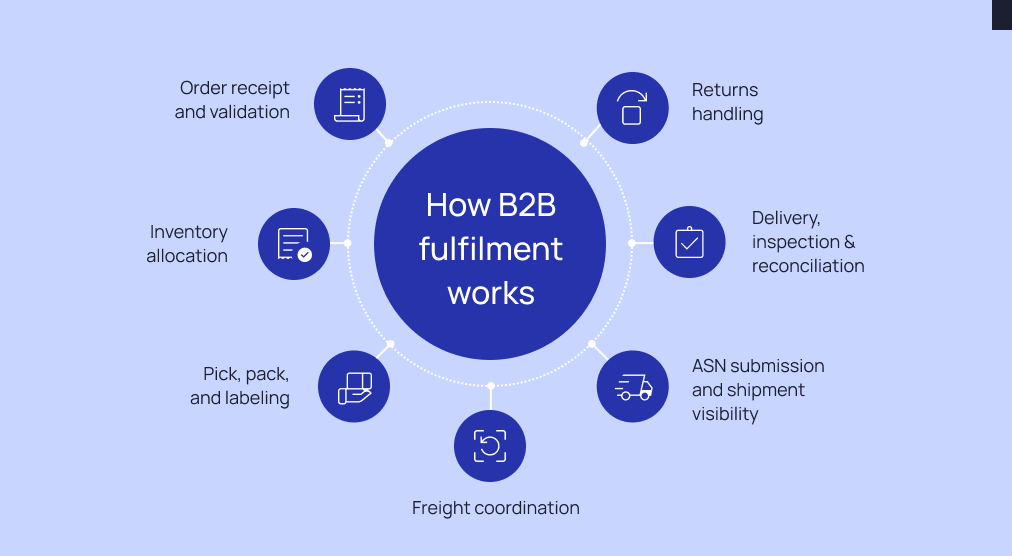
B2B fulfillment usually follows a structured workflow from order receipt to post-delivery reconciliation. While the exact process varies by buyer and channel, most operations move through the same core stages.
a. Order receipt and validation
Most B2B orders arrive through Electronic Data Interchange (EDI), supplier portals, or direct account orders. The order is then checked against inventory availability, buyer requirements, shipping rules, and account-specific compliance conditions before inventory is allocated.
b. Inventory allocation
Once validated, inventory is reserved against the purchase order. This step becomes more difficult when stock is spread across multiple warehouses or when businesses rely on delayed or manual inventory updates. Inaccurate inventory data can cause allocation mistakes, overselling, backorders, or late fulfillment.
c. Pick, pack, and labeling
B2B operations often require pallet-level or carton-level picking, retail-ready packaging, and buyer-specific barcode or label formats. Under the GS1 Logistic Label standard, each logistic unit must carry a unique SSCC (Serial Shipping Container Code). That identifier supports matching the physical movement of goods with electronic business messages such as the Despatch Advice or ASN. If the SSCC or related data does not align with the ASN or the actual goods acquired, receiving and stock updates may be disrupted [1]. The guideline also allows additional customer and carrier-specific information, including routing and handling data.
d. Freight coordination
In many retail and wholesale environments, the buyer may set carrier, routing, labeling, and shipment requirements through vendor manuals or similar standards. Non-compliance with these standards can lead to deductions, delivery delays, or broader vendor compliance issues.
e. ASN submission and shipment visibility
Before or at shipment, suppliers may send a despatch advice or ASN so the receiving party can match the physical shipment with the related electronic message. If the SSCC or related shipment data does not align with the ASN or the goods acquired, receiving and stock updates may be disrupted.
f. Delivery, inspection, and reconciliation
When the shipment arrives, the receiving business inspects it against the purchase order and ASN. Differences in quantity, condition, timing, or documentation can lead to disputes, deductions, or rejected deliveries.
g. Returns handling
Returns in B2B are often governed by account terms and operational agreements rather than standard consumer return policies. The exact process varies by buyer, product type, and channel.
3. Key differences between B2B and B2C fulfillment
B2B and B2C fulfillment rely on some of the same infrastructure, but the operating model is different in practice. B2B is usually more document-heavy, freight-driven, and compliance-sensitive. B2C is usually faster, lighter, and built around parcel delivery and consumer expectations.
| Factor | B2B fulfillment | B2C fulfillment |
| Order size | Large bulk orders | Individual units or small baskets |
| Shipping method | Freight-based or scheduled commercial delivery | Parcel carriers |
| Compliance | Compliance-heavy with EDI, routing guides, and buyer requirements | Minimal compliance |
| Lead times | Days to weeks | Hours to days |
| Documentation | Purchase orders, ASNs, invoices, pallet labels | Shipping label and order confirmation |
| Returns | Negotiated terms, formal RMAs (Return Merchandise Authorization) | Consumer-driven return policies |
The biggest difference between B2B and B2C fulfillment is compliance exposure. In B2B environments, compliance failures can have direct financial consequences at the order level.
For businesses managing both channels, this is where dedicated systems matter. For a closer look at what B2B operators need to know before entering the consumer space, Anchanto’s B2C fulfillment handbook is a useful starting point.
Benefits of optimizing B2B fulfillment
The benefits of optimizing B2B fulfillment are lower operational friction, better service performance, and stronger buyer relationships. When the process is stable, businesses tend to reduce avoidable errors while improving the metrics buyers actually track.
Key benefits include fewer chargebacks and compliance disputes, better on-time delivery performance, higher fill rates and order accuracy, faster order cycle time, better inventory visibility across locations, and stronger readiness for retail expansion or multichannel growth.
Efficient systems and clearer cost visibility help operations teams understand where money is being spent and make better decisions about improving warehouse performance and service levels.
Common mistakes in B2B fulfillment
While you can optimize your B2B fulfillment to enable processes to run smoothly, there is a chance that errors can impact performance. B2B fulfillment tends to break down in a few predictable places. This can lead to delays, deductions, higher labor costs, poor visibility, or growing exception volumes. Let’s look at what what these mistakes are so you can avoid them.
Managing EDI compliance manually
Every major buyer runs different EDI mapping, ASN, invoice, and acknowledgment requirements. For 3PLs and wholesalers handling multiple accounts, trying to manage these compliance profiles manually increases the risk of order failures and data mismatches that could have been avoided.
Operating without real-time inventory visibility
When inventory data is delayed or fragmented across warehouse sites, businesses cannot allocate bulk orders correctly or keep promises to buyers. The result is backorders, cancellations, and avoidable split shipments across large order volumes.
Ignoring retailer compliance standards
Deviating from a buyer’s approved carriers, shipping windows, labeling standards, or appointment rules leads to chargebacks, receiving delays, and broader vendor compliance consequences. In large retail supply chains, these penalties accumulate quickly and can represent a significant percentage of the cost of goods.
Waiting too long to scale order and warehouse management
As bulk order volumes grow, labor needs shift, warehouse space becomes strained, and simple processes no longer hold up. For 3PLs and wholesalers, waiting too long to address these gaps with the right automations leads to missed orders, slower delivery, and strained buyer relationships.
Keeping fulfillment costs siloed
When warehouse and shipment data, payroll, and facility costs sit across separate functions, operations teams lose sight of where money is going. For businesses processing large order volumes, this makes it very difficult to identify cost increases or make a case for process improvements.
B2B fulfillment costs: What businesses should expect
B2B fulfillment costs vary by order profile, product characteristics, account complexity, storage needs, freight mix, and whether fulfillment is managed in-house or outsourced. There is no single benchmark that fits every business, but most cost models include the same major categories.
The main cost buckets are warehousing and storage, pick and pack labor, freight, packaging and labeling materials, EDI and platform fees, returns processing, and chargeback exposure.
Chargebacks and compliance penalties deserve separate attention because they are often underestimated. According to Walmart’s OTIF (On-Time In-Full) compliance program, suppliers who fail to meet delivery targets are fined 3% of the cost of goods on non-compliant cases.
As of early 2024, Walmart’s published OTIF targets require collect-ready suppliers to meet a 98% on-time threshold, prepaid suppliers to meet 90% on-time, and all suppliers to achieve 95% in-full. [2] Other major retailers operate similar compliance programs, making chargeback exposure a meaningful and recurring cost category for B2B suppliers.
According to F. Curtis Barry & Company, a warehouse operations and fulfillment consultancy, most businesses spend between 5% and 15% of gross sales on fulfillment costs. Efficient operations tend to sit at the lower end, while operations with low average order values or limited automation may trend higher. [3]
According to a 2023 analysis published in Inside Supply Management (ISM), a practical way to assess fulfillment cost is not only as a percentage of net sales, but also through more granular measures such as cost per order, cost per order line, and cost per box shipped. Keeping labor, facility, and packaging costs separated helps teams identify where increases are coming from. [4]
In-house vs 3PL B2B fulfillment: Which is better?
Neither model is universally better. The right choice depends on volume stability, order complexity, geographic footprint, internal capabilities, and how strategically important fulfillment is to the business.
In-house fulfillment gives the business more direct control over inventory, labor, service levels, and compliance processes. It tends to make more sense when demand is stable, operations are large enough to support fixed infrastructure, and fulfillment capability is a strategic advantage. The tradeoff is higher fixed cost and the need to invest in systems, labor management, and process improvement.
3PL fulfillment converts more of the cost base into a variable model and can help businesses scale without immediately adding warehouse space, headcount, or specialized systems. This is often attractive for fast-growing businesses, businesses entering new regions, or teams that do not want compliance execution to depend on internal warehouse buildout. The tradeoff is less day-to-day operational control and greater reliance on the provider’s systems and processes.
Hybrid fulfillment lets the company keep core fulfillment in-house while using 3PLs for overflow capacity, seasonal peaks, new markets, or specialist categories. That can be a useful middle ground when the business wants both control and flexibility.
Role of technology in B2B fulfillment
Technology is what separates B2B fulfillment operations that scale smoothly from those that slow down under volume. The more buyer requirements, warehouses, and volume you add, the more important integrated systems become.

Order management system (OMS)
An order management system consolidates orders across EDI, portals, and direct integrations. The system also applies business rules, allocates inventory, and routes orders through the fulfillment workflow. For teams managing multiple buyer requirements, an OMS creates a single view of status, exceptions, and fulfillment priorities. Anchanto’s order management solution supports B2B operations in centralising order flows, inventory allocation, and exception management across channels.
Warehouse management system (WMS)
A warehouse management system controls receiving, putaway, picking, cycle counting, labor activity, and location-level inventory movement. For businesses dealing with account-specific packaging and labeling requirements, a strong WMS is hard to replace.
EDI platform
An EDI platform automates document exchange with buyers. When integrated properly with the OMS and warehouse processes, it can help reduce manual re-entry and support more consistent order processing and ASN accuracy.
Inventory management
Connected inventory management gives a business better visibility across storage sites, stock pools, lot numbers, and allocation rules. For any team figuring out how to manage inventory for B2B fulfillment across multiple locations, this is the foundation that the rest of the operation depends on.
ERP integration
An ERP ties order execution to invoicing, payment terms, and reconciliation. When order, warehouse, inventory, and finance systems work together without manual intervention, the operation tends to be more resilient at scale.
How to choose the right B2B fulfillment strategy for your business
The right B2B fulfillment strategy depends on how complex your operation is today and how much complexity you expect to add. The goal is not just to ship orders, but to do it in a way that protects service levels, margin, and buyer relationships.
A useful way to decide is to assess five areas.
1. Order complexity
Look at average order size, mixed-SKU requirements, pallet or carton rules, and account-specific packaging demands.
2. Compliance burden
Review how many buyers require EDI, routing guide adherence, ASN accuracy, delivery appointments, or custom labeling.
3. Network footprint
Consider how many warehouses, regions, and shipping modes you need to coordinate.
4. Systems maturity
Assess whether your OMS, WMS, inventory tools, and finance systems already work together or still rely on manual intervention.
5. Growth plans
Think about whether you are entering new retail accounts, new markets, or new channels that will increase fulfillment complexity in the next 12 to 24 months.
If fulfillment costs are trending upward, it is worth drilling into the underlying causes. These could be congestion, packaging changes, outdated warehouse technology, or space inefficiencies. Bottlenecks must be addressed before they become more costly. For many businesses, fulfillment cost analysis point to the need for stronger systems, tighter integrations, or a more capable fulfillment model.
B2B fulfillment is where supply chain complexity becomes operationally visible and financially consequential. Getting it right requires strong order management, EDI capability, reliable freight coordination, and real-time inventory visibility working together.
If your operation is under pressure from growing buyer requirements or rising order volumes, Anchanto’s order management solution and warehouse management solution can offer valuable support in terms of automation, efficiency, visibility, and control..
FAQs
1. How is B2B fulfillment different from B2C fulfillment?
B2B fulfillment handles larger orders shipped to businesses under stricter compliance conditions, often involving EDI, routing guides, formal documents, freight coordination, and chargeback risk. B2C fulfillment is built around individual consumer orders with lighter compliance requirements and faster parcel delivery.
2. What are the key challenges in B2B fulfillment?
The main challenges are EDI compliance, inventory visibility, routing guide adherence, manual exception handling, and disconnected systems. Most become harder as order volume, account complexity, and multichannel operations increase.
3. What systems are required for B2B fulfillment?
Most mature B2B operations rely on an OMS, WMS, EDI platform, inventory management capability, and ERP integration. The OMS is often the highest-leverage investment because it connects order flow, inventory allocation, and exception management across channels.
4. Can B2B fulfillment be automated?
Yes. EDI can automate document exchange, an OMS can automate routing and allocation rules, and a WMS can automate warehouse workflows such as directed picking and labeling. The more integrated the stack is, the less manual intervention is needed.
5. When should a business switch to a B2B fulfillment solution?
Businesses usually need a stronger B2B fulfillment solution when chargeback exposure is increasing, order errors rise with volume, or new retail and distribution accounts add more compliance complexity than the current process can support.
References:
[1] Gs1.org – GS1 Logistic Label Guideline
[2] Spscommerce.com – Walmart’s OTIF Performance Metrics
[3] Fcbco.com – Understanding Fulfillment Costs to Improve Warehouse Operations
[4] Ismworld.org – The Monthly Metric: Fulfillment Cost Per Order