
1. Introduction
In recent years, the world of e-commerce has witnessed a dramatic rise in popularity as a result, the e-commerce landscape has become a competitive arena with brands and retailers of all sizes.
To truly comprehend the magnitude of the online retail competition in 2026, here are some astonishing figures to consider:
- 2 million businesses worldwide sell on Amazon [1]
- 1 million+ brands and retailers sell on Lazada [2]
- 18.3 million+ sellers have accounts on eBay [3]
Beyond these, other major marketplaces across the globe are also seeing thousands of businesses signing up to their platforms.
So, how do you stand out in the loud and crowded e-commerce space?
Also, how do you deal with price wars? How do you identify and reduce potential gaps between your and your competitor’s offerings? How do you hold onto your market share and revenue while expanding profitably?
The solution is simple – digital shelf analytics.
But before we dive into this, let’s see how far you can get without real-time market insights.
2. E-commerce Can Work Without Digital Shelf Analytics, But at a Cost!
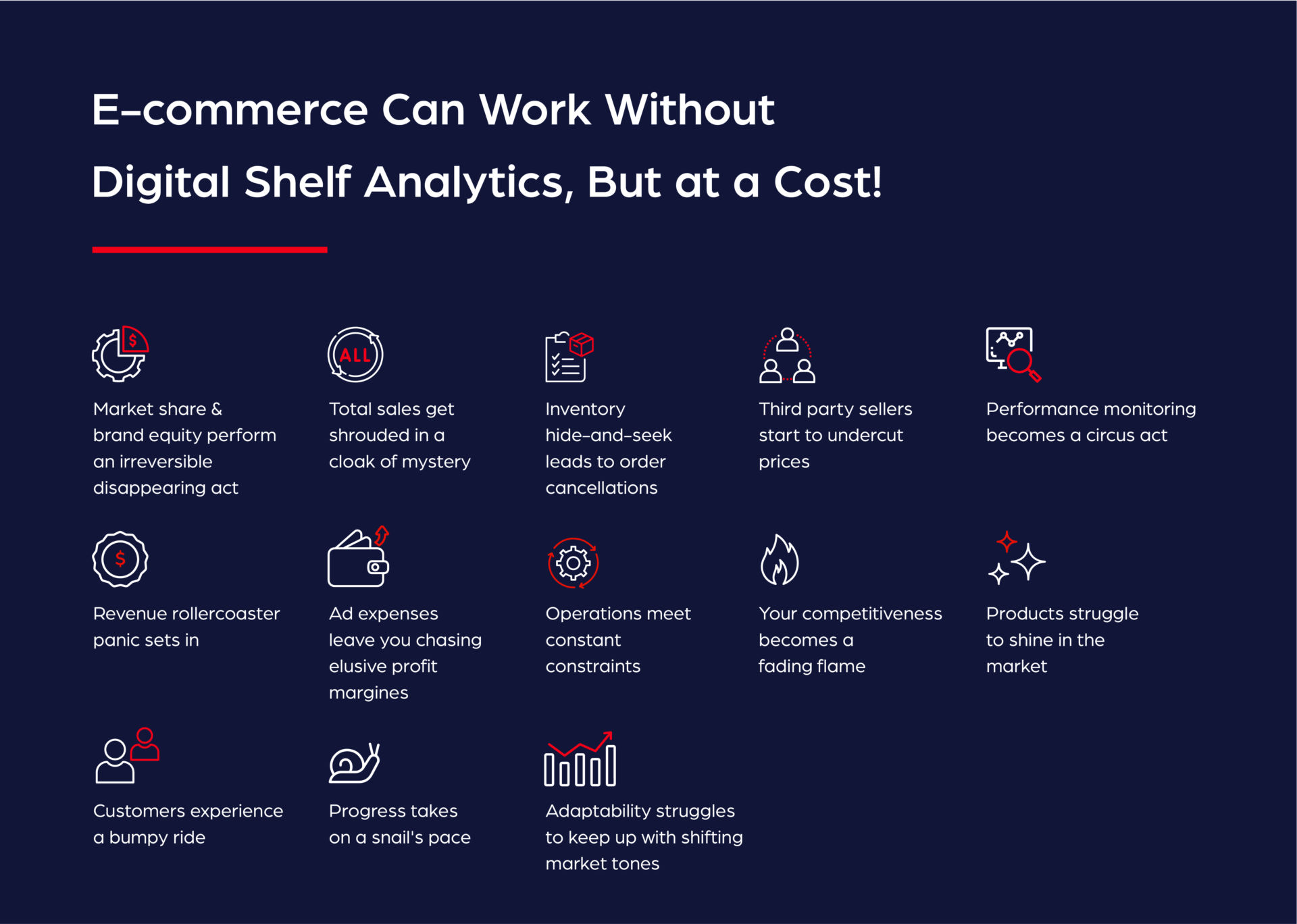
While you can sell online without digital shelf analytics, its absence comes with a long list of costly challenges that impact business performance and growth. Here are some of the situations that may occur:
- Market share and brand equity perform a disappearance act
Not knowing your share of search or position in the e-commerce market against your competitors can lead to ill-informed decisions. The parameters for competing will also be unknown without knowledge of what your competitors are doing better than you.
- Total sales become shrouded in a cloak of mystery
The inability to track your own sales will lead to inaccurate revenue and profit calculations. It will also impact your pricing and promotions strategy. Effective pricing is crucial to maintain e-commerce competitiveness. But with a lack of valuable data on competitor pricing, price elasticity, and market trends your businesses may struggle to set competitive prices, potentially leading to lost sales or lower profit margins.
- Inventory hide-and-seek leads to order cancellations
Misrepresenting stock online can lead to overselling or out-of-stock products that cause customers to cancel orders frequently. Without the right means to track inventory across your storage locations you won’t be aware of your low stock levels or buffer stock.
- Third party sellers start to undercut prices
Grey sellers and resellers may undercut your brand’s authorized price leading to reduced profit margins. Without digital shelf analytics to monitor their market listings, tracking their pricing and holding them accountable is difficult.
- Performance monitoring becomes a circus act
Without the process to generate digital shelf health analysis, you have to monitor your and your competitors’ business performance manually. This will require dedicated resources to track and analyze data, which can be inefficient, especially as the business scales or in the case of brands with complex distribution networks.
- Revenue rollercoasters panic sets in
Failing to price your products competitively (that is if you overprice or underprice products) and not knowing what customers want will affect your profits and revenue significantly. Working against customer expectations is only going to enhance your expenses and diminish profits.
- Ad expenses leave you chasing elusive profit margins
A lack of visibility on the share of search and keyword ranks will affect your ad and SEO bids, causing poor return on ad investment. You need to know what your target audience is looking for when it comes to your products. Based on this insight you identify the keywords ideal prospects use to ensure they reach your product listings.

- Operations meet constant constraints
Your business may struggle to make data-driven decisions and may not be able to fully optimize their e-commerce operations without insights from digital shelf analysis. This can impact optimizing product visibility, pricing, assortment, and merchandising
- Your competitiveness becomes a fading flame
In the highly competitive e-commerce landscape, if you lack digital shelf health analysis, you may find it challenging to stay competitive. Without an understanding of customer preferences, pricing strategies, and market trends, your competitive advantage reduces, you miss growth opportunities, fail to identify potential issues or gaps, and struggle to respond effectively to market changes. Moreover, you cannot monitor competitor insights like price changes, promotional strategies, and customer reviews. This can leave you blindsided by your competitors’ moves.
- Products struggle to shine in the market
Digital shelf analytics provides insights into how products are positioned, displayed, and presented on e-commerce platforms. Without this information, your business may struggle to optimize product visibility resulting in lower discoverability, reduced click-through rates, and ultimately, decreased sales. You also lose sight of your third-party sellers’ performance with your products and become dependent on their delayed (and sometimes erroneous) sales reports.
- Customers experience a bumpy ride
Understanding customer preferences is essential in e-commerce today. Without customer behavior data, such as search patterns, browsing habits, and purchase preferences, your team and partners may find it challenging to select the right mix of products to meet customer demand, leading to inventory inefficiencies and missed sales opportunities. You will also have limited insights to optimize product placement, product descriptions, and visual elements to enhance the customer experience.
- Progress takes on a snail’s pace
Analyzing your digital shelf allows your business to monitor performance metrics, track key performance indicators (KPIs), and identify areas for improvement. Without this data, you may struggle to identify and address issues, potentially leading to stagnation and missed growth opportunities.
- Adaptability struggles to keep up with shifting market tones
E-commerce is a dynamic and rapidly evolving landscape. Without insights into market changes and emerging trends, your teams may find it challenging to adapt strategies and offerings to evolving customer demands.
3. Components of the Digital Shelf Analytics Process
No matter the sport, you want to be prepared with knowledge of your capabilities, competition, the playing field, and smart tactics to win before stepping into the game.
With online retail, it’s no different.
But how you collect information on your performance, the competition, the playing field, and put together your play (or strategy) can significantly impact your outcome.
Here are some of the resources commonly used to gather digital shelf and market insights in e-commerce — and what each one is best used for:
a. Market data reports from companies like Nielsen Holdings, Gartner, and Forrester Research are strong for category-level trends, market sizing, and competitive benchmarking. They’re best used to set strategy and check direction periodically, rather than for day-to-day decisions, since they’re published on a fixed cycle rather than in real time.
b. Business intelligence (BI) tools are excellent for turning raw data like your own sales, inventory, pricing, etc., into the dashboards and analysis your teams actually act on. Getting the most out of them means investing some time upfront in mapping and consolidating data from your various sources, but that setup pays off in faster, clearer decision-making afterward.
c. OMS dashboards consolidate your orders, inventory, pricing, and catalogue data across every channel you sell on, giving you one consistent, real-time view of your own operations instead of toggling between marketplace seller dashboards. They’re the strongest option for monitoring and acting on your own performance.
d. Manual research and analysis still has a place, particularly for competitor and market-side insights that no internal system can see. (For example, competitor listings, reseller pricing, or content benchmarking.) It takes more hands-on effort and works best as a scheduled, recurring exercise (weekly or monthly) so the insights stay current.
4. What Does a Digital Shelf Analytics Process Cover? Which Capabilities Do Enterprises Rely On?
A mature digital shelf analytics process goes beyond basic online presence tracking. It covers a comprehensive set of capabilities that enable brands and retailers like you to gain a competitive edge.
It gives you visibility into product availability, content quality, pricing strategies, competitor activities, and customer sentiment. The right combination of market data reports, BI tools, OMS dashboards, and structured research lets you make data-driven decisions, improve your digital shelf performance, and accelerate growth.
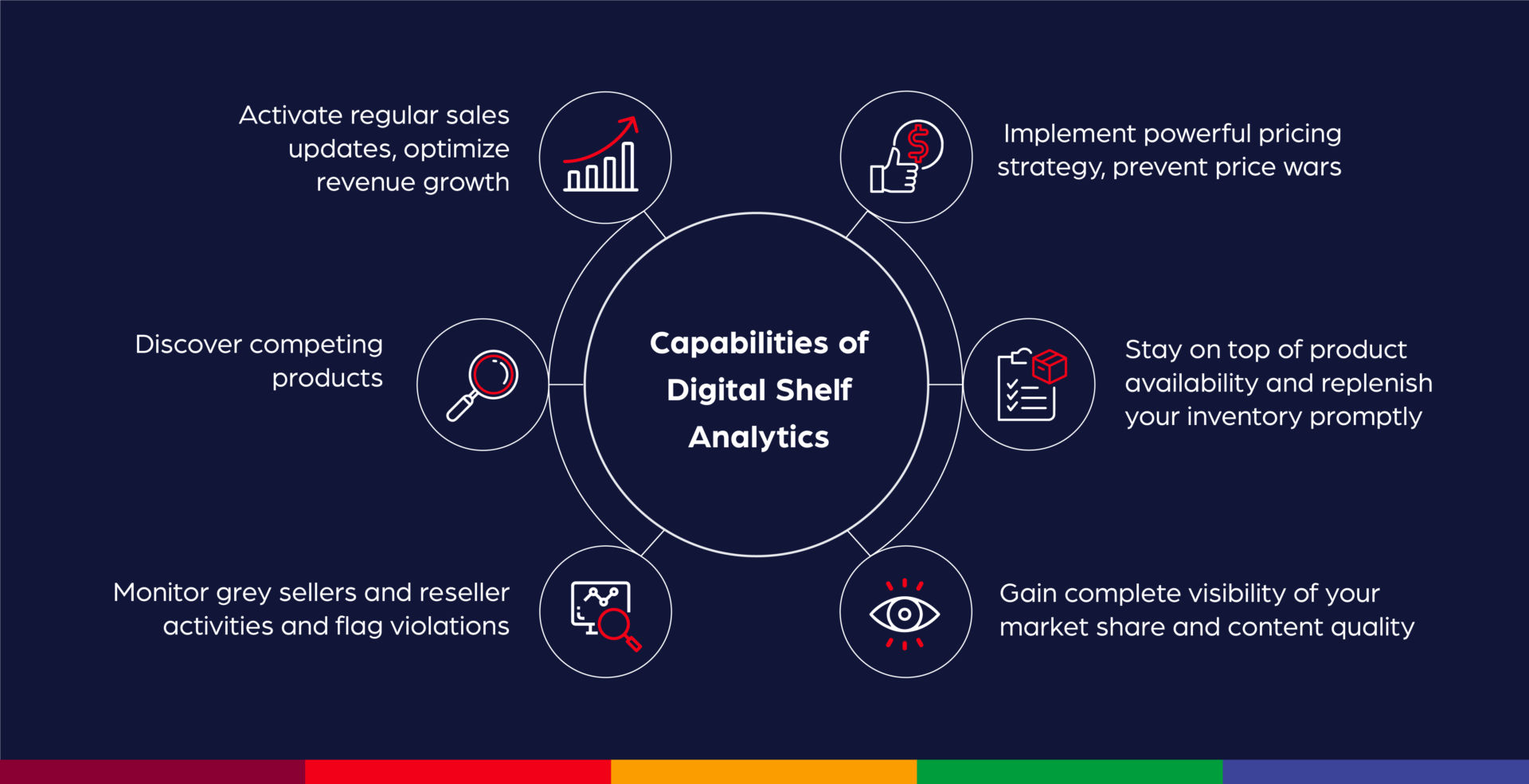
Let’s dive deeper into the top capabilities of this technology and their impacts:
a. Implement powerful pricing strategy, prevent price wars
Monitor price trends in your industry and use them to price new products competitively. Compare your existing products against similar ones in the market to determine if you have overpriced or underpriced, and act quickly to avoid losing revenue in price wars. Tracking competitor discounts and promotions helps you keep your own pricing sharp and relevant.
Best tools for this: Market data reports (Nielsen, Gartner, Forrester) and BI tools are best suited for tracking competitor pricing and category trends. For managing and executing your own pricing across channels in real time, in response to market trends, an OMS like Anchanto’s gives you centralized control across all your sales channels.

Source [4]
b. Gain complete visibility of your market share and content quality
Understanding how your content (i.e., product images, descriptions, and listings) compares to the market helps you sharpen the customer experience. Sentiment scoring based on online ratings and reviews shows you how customers actually perceive your products. Some brands also benchmark their visibility, engagement, and traffic against competitors’ to measure share of search and fine-tune their customer touchpoints.
Tracking things like search visibility, customer sentiment, and content quality against competitors in real time requires paid tools built for that. There’s no easy workaround. Without those tools, the alternative is doing it manually by regularly checking your own listings and a sample of competitors’, then rating them using the same set of criteria each time. One can employ Ai. However, gathering the data would still require manual intervention.
Best tools for this: Market data reports and specialist market intelligence or social listening tools are ideal for a competitive view. On your own side, an OMS centralizes your product catalogue and content across channels, so you at least have a clean, consistent baseline of your own listings to benchmark against the market.
c. Stay on top of product availability and replenish your inventory promptly
Monitor your product availability across sales channels to stay ahead of low stock and stockouts. Where possible, also keep an eye on your competitors’ product availability and new launches to understand shifts in the competitive landscape, and compare your sell-through against similar products to plan replenishment more effectively.
Best tools for this: For your own inventory, an OMS (for virtual inventory visibility) and WMS (for physical inventory ops, and replenishment strategies) are the natural fit. It gives you a real-time, centralized view of stock across warehouses and sales channels, flags low or out-of-stock items, and helps you plan replenishment before you lose sales. For competitor availability and launch tracking, that still falls to manual monitoring, since this is external data outside any OMS’s reach.
d. Activate regular sales updates, optimize revenue growth
Get a clear, regular picture of your GMV by marketplace, brand, retailers, distributors, and category. Track top and low-performing products by units sold and GMV, and use channel-performance data to guide decisions. Sales and marketing teams can use reports by price range and units sold to fine-tune revenue strategy.
Best tool for this: With order, inventory, and sales information consolidated across every channel, an OMS like Anchanto’s gives you near real-time GMV and sales reporting without manually reconciling data from a dozen marketplace dashboards.
e. Monitor grey sellers and reseller activities and flag violations
Keeping an eye on how resellers and grey-market sellers price your products helps protect your brand’s authorized pricing and revenue. Comparing official store pricing against third-party listings makes it easier to spot patterns that may indicate unauthorized discounting or distribution.
Today, there are tools available for live monitoring of marketplace listings. They conduct periodic audits like spot-checking key marketplaces and listings on a set schedule for example, weekly, monthly or around major sales events and help identify unauthorized sellers.
Best tools for this: An OMS can confirm your own authorized pricing and distribution data is accurate and consistent, which gives you a clean baseline to compare against when you do audit. But unauthorized sellers will have to be identified through marketplace monitoring tools.
f. Discover competing products
Observe different marketplaces to identify competing products and compare them side by side against the things that matter to you. This may include price, review scores, discounts, and positioning. You can identifying similar products by category or keyword, and tracking their pricing history and promotions over time by maintaining records to help spot gaps and opportunities in your own range.
Best tools for this: You can use market data reports, category research, and competitor tracking tools for visibility into other brands’ listings and pricing history. These tools can give you actionable insights and when you put the relevant information into your OMS, it can help you revamp and implement your new listings in real-time.

5. Time to Out Perform with Digital Shelf Analytics
The future of Digital Shelf Analysis is promising for brands and retailers aiming to gain a competitive advantage. By leveraging digital shelf data, you can make informed decisions, optimize product offerings, and enhance the customer experience.
In today’s fast-paced business environment, not embracing digital shelf analytics is a risk you cannot afford to take. Disregarding the power of data-driven decision-making with technology solutions can lead to a major loss. That’s because data is the ultimate requirement to maximize your digital shelf presence and minimize competition and loss of market share.
Now is the moment to seize the advantages of digital shelf analytics. By investing in this process, you can position your brand at the forefront of the industry, outperform rivals, and captivate their customers with tailored offerings and exceptional experiences. The future belongs to those who recognize the value of doing this well and act upon it. Don’t miss out on the incredible opportunities awaiting your brand in the world of digital shelf analysis.
Looking for an OMS to build your digital shelf analytics process?
Reach out to our e-commerce experts!
References
[1] Forbes.com – How To Step Up Your Game As An Amazon Seller In 2023
[3] Businessofapps.com – eBay Revenue and Usage Statistics (2026)
[4] Researchgate.net – Profiting When Customers Choose Value Over Price