
Cross-Docking: Meaning, Process and Benefits Explained
Blogs
Today’s delivery expectations are high, and meeting them requires smarter logistics, not just faster shipping. McKinsey shares that over 90% of online shoppers [1] expect free two- to three-day shipping.
Cross-docking is one way to achieve that. It reduces the need for storage by moving goods directly from inbound to outbound transport. While it may appear complex on the surface, its core principles are simple: minimizing storage and optimizing transportation. At its core, cross-docking is about minimizing storage and optimizing transportation.
In this blog, we’ll break down how cross-docking works, where it fits in your supply chain, and what to know before implementing it.
What is Cross-Docking?
Cross-docking is a logistics used to move goods quickly from inbound to outbound transport with little or no storage in between. The goal is to reduce storage time, lower labor costs, and increase delivery speed across the supply chain.
When goods arrive at a cross-docking terminal, they’re sorted and transferred directly to outbound trucks for delivery. This allows companies to ship products faster without the need to store inventory or process it through a traditional warehouse.
This method, drastically cuts storage costs by keeping products in motion instead of sitting idle in warehouses. Retailers like Walmart use cross-docking [2] to consolidate goods from multiple suppliers and quickly deliver them to stores, avoiding long-term storage.
How Cross-Docking works
Cross-docking works by receiving goods at a central location and immediately sorting and transferring them to outbound transport with minimal or no storage. The process typically involves three key stages: receiving, handling, and dispatch.
1. Receiving
Cross-docking usually takes place at a facility operated in-house or by a third-party logistics (3PL) partner, where inbound shipments arrive at the terminal, usually from suppliers, manufacturers, or other warehouses. The receiving team unloads the goods and verifies the quantity, condition, and destination of each item.
This is a crucial first step, especially in time-sensitive operations like grocery distribution, where product shelf life is limited.
2. Handling
After verification, goods are sorted based on their next destination. Depending on the type of product and the cross-docking strategy, handling can include:
- Sorting items by delivery route or final location
- Consolidating smaller shipments into one load
- Repackaging or labelling, if required
Goods are then moved to a staging area, where they’re grouped with other shipments headed in the same direction and loaded onto outbound trucks. This step is usually supported by Warehouse Management Systems (WMS) or other ERP software to avoid delays.
3. Dispatch
Once sorted and consolidated, goods are quickly moved to the outbound dock. Vehicles are loaded based on route schedules and destination priorities. The objective here is speed and precision.
A typical cross-dock facility may handle multiple rounds of dispatch per day, especially for fast-moving consumer goods or time-sensitive freight. The entire process depends on tight coordination, accurate inventory tracking, and real-time communication between suppliers, warehouses, and carriers.
Types of Cross-Docking

As the logistics and supply chain industry evolve, cross-docking is playing a bigger role in replacing traditional distribution methods that rely on long-term storage. There are two main types of cross-docking strategies, depending on whether the final destination is known before or after goods arrive at the facility:
Pre-Distribution Cross-Docking
In pre-distribution cross-docking, the destination of each item is known before the goods arrive at the terminal. Suppliers identify the final recipient of each product before shipping to the cross-dock warehouse. Once the goods arrive, they are immediately unloaded, sorted, and potentially repackaged according to these pre-set distribution instructions. This approach, characterized by minimal storage and handling time, is ideal for scenarios where demand is predictable and inventory allocation is known in advance.
Post-Distribution Cross-Docking
On the other hand, in post-distribution cross-docking, the final destination of goods is decided only after they arrive at the facility. This provides time to assess demand data or stock levels before assigning items to delivery routes. Packages may be temporarily held at the staging area until decisions are finalized. While this results in slightly longer holding time compared to pre-distribution, it gives businesses flexibility, particularly in fluctuating markets or when demand forecasting is challenging.
Specialized forms of cross-docking
Other specialized forms of cross-docking have emerged to meet the needs of different industries. While the core process remains the same, each variant adapts to the specific flow of goods and fulfillment goals.
1. Retail Cross-Docking
Retail cross-docking simplifies the journey from supplier to store by skipping storage steps. Goods are sorted by location and sent out the same day, reducing inventory costs and speeding up shelf availability.
2. Manufacturing Cross-Docking
Manufacturing cross-docking supports just-in-time workflows. Components are delivered directly to production lines instead of being stocked in a warehouse, helping minimize waste and unnecessary storage.
3. E-Commerce Cross-Docking
E-commerce cross-docking helps online retailers speed up order processing. Items are sorted by order or region and shipped immediately to the customer, making it easier to meet 1 or 2-day delivery expectations.
Key Components of Cross-Docking
A cross-docking system depends on several moving parts working in sync. Let’s look at the critical components that enable smooth operations:
1. Cross-dock facilities
These are high-throughput distribution centers built for speed. Most follow an I-shape or U-shape layout with separate zones for incoming and outgoing shipments. They are usually located near ports, airports, or highway networks to reduce transit time and improve delivery speed.
2. Dock areas and layouts
Each area is designed to keep goods flowing without delay. This includes spaces for unloading and inspection, zones for sorting and grouping by destination, temporary holding when needed, and outbound docks ready for immediate loading.
3. Equipment and automation
Conveyor belts, forklifts, sensors, and robotic sorters help move goods efficiently across the floor. Automation tools reduce manual work and allow for faster processing of large volumes.
4. Warehouse Management Systems (WMS)
WMS software tracks inventory in real time, matches orders to shipments, and helps plan outbound loads. It often connects with barcode scanners or wearable tech to improve speed and accuracy during handling.
5. Transportation and scheduling systems
Tools like Transportation Management Systems (TMS) coordinate inbound and outbound shipments. Real-time scheduling software helps assign dock slots, plan trailer movements, and reduce truck idle time.
6. Tracking and identification technology
Barcode systems and RFID tags allow teams to monitor inventory and shipment status live. These tools ensure accurate handoffs and help reduce missed or delayed deliveries.
7. Personnel and workforce
Cross-docking warehouse operations require trained staff for sorting, quality checks, and equipment handling. Logistics engineers and shift managers support the system to ensure operations run smoothly and safely.
8. Communication and integration tools
Real-time communication tools and ERP integrations help teams stay aligned. These systems support demand forecasting and give full visibility across suppliers, carriers, and warehouse teams.
Benefits of Cross-Docking
Cross-docking process is widely used to improve supply chain efficiency while reducing operational costs. It speeds up order fulfillment, reduces inventory carrying costs, improves product handling, and increases transport efficiency. Key benefits include:
- Accelerated Delivery Time: Cross-docking dramatically shortens delivery timelines by minimizing or eliminating warehouse storage. This is particularly important for retailers and e-commerce businesses where customers expect fast last-mile delivery.
- Minimized Inventory Costs: Cross-docking substantially reduces expenses associated with warehousing, including storage fees, labor, security, and insurance. It also frees up working capital that would otherwise be tied up in inventory holding.
- Reduced Risk of Product Damage: The number of touchpoints (unloading and repackaging) is comparatively less in cross-docking warehouse process than traditional warehousing, which significantly lowers the risk of product damage. This is useful for perishable items such as dairy or fresh produce, where time in storage directly affects quality and shelf life.
- Optimized Shipping Costs: Cross-docking services enables efficient load consolidation and deconsolidation, allowing businesses to fill trucks more efficiently and reduce transportation costs. Combining loads by region helps companies reduce the number of partial truckloads and improve route efficiency.
Challenges & Limitations of Cross-Docking
While cross-docking can improve supply chain speed and efficiency, it also introduces challenges that require planning, investment, and precise coordination. To be successful, cross-docking needs the right infrastructure, real-time visibility, and seamless alignment between suppliers, carriers, and warehouse teams. The following are its limitations and challenges:
- Costly Initial Investment: Implementing a cross-docking operation requires substantial capital. The setup usually includes establishing custom-built or retrofit terminals, investing in advanced warehouse automation technologies, such as robotics and sensor systems, to ensure seamless operations and real-time tracking.
- Dependency on Strict Coordination: Cross-docking process only works when the timing of inbound and outbound shipments is perfectly aligned. Delays from suppliers or carriers can cause backups, missed deliveries, or stalled shipments. Unexpected issues such as traffic, weather delays, or labor shortages at any link in the chain can disrupt the entire flow. Effective communication between suppliers, logistics teams, and carriers is critical. Most businesses use WMS or ERP systems to manage real-time updates and reduce the risk of scheduling conflicts.
- Risk of Demand Forecasting Errors: Since cross-docking minimizes buffer stock, demand planning needs to be highly accurate. Overestimating can lead to excess inventory downstream, while underestimating may cause missed orders or delays. Retailers with fluctuating demand or seasonal peaks must invest in demand forecasting tools or risk breakdowns in the system.
- Limited Flexibility in Order Fulfilment: Cross-docking is ideal for predictable, high-volume SKUs but less suited for made-to-order or frequently changed orders. Once goods are in motion, making changes to destination, quantity, or packaging becomes difficult. This limits flexibility in dynamic environments like custom manufacturing or on-demand fulfillment.
- Product Handling Complexity: Cross-docking may also fall short when handling fragile, hazardous, or temperature-sensitive items. These products often need special handling, slower processing, or temporary storage, which contradicts the fast-paced cross-docking model.
- Skilled Workforce and Operational Complexity: Operating a cross-dock terminal requires trained personnel who can rapidly sort, scan, and dispatch goods without errors. As volume increases, managing accuracy, dock assignments, and staging becomes more complex. Without a skilled team and clear processes, even minor issues can lead to delivery errors or supply chain bottlenecks.
Cross-Docking vs. Traditional Warehousing
Now that we’ve covered the pros and cons of cross-docking, let’s compare it to a more traditional model, which is warehousing. The core difference essentially lies in how goods are managed after arrival. One system stores inventory, the other keeps it moving.
Below is a side-by-side overview of how cross-docking warehouse operations and traditional warehousing compare across different criteria:
| Features | Cross-Docking | Traditional Warehousing |
| Primary goal | Rapid transfer of goods from inbound to outbound transport with minimal or no intermediate storage. | Long-term storage of inventory to manage stock levels and fulfill orders over time. |
| Storage time | Minimal to none (typically 24-48 hours or less); immediate transfer. | Extended periods; days, weeks, or months, to buffer against demand fluctations. |
| Inventory levels | Low on-hand stock; relies on just-in-time arrivals and pre-planned allocations. | High levels of stored inventory, maintaining safety stock levels, with regular cycle counts and audits for accuracy. |
| Operational speed | Fast; immediate transfer from inbound to outbound vehicles. | Slower; dependent on storage and retrieval. |
| Overall costs | Lower storage costs, but higher coordination and technology costs. | Higher storage and labor costs for inventory management. |
| Flexibility | Limited flexibility for last-minute changes. | More flexibility for storage and order adjustments. |
| Risk Factors | Higher risk of disruptions from timing mismatches or supply chain delays. | Greater risk of obsolescence, damage, or theft from prolonged storage. |
| Suitable for | Best for perishables, retail, and e-commerce with steady demand (e.g., groceries, fashion). | Ideal for manufacturing, bulk goods, or products with irregular demand (e.g., electronics, seasonal items). |
Cross-Docking vs. Dropshipping
Dropshipping and cross-docking are two distinct methods used to move products efficiently through the supply chain. In dropshipping, retailers sell products without holding inventory. When a customer places an order, the item is shipped directly from the supplier, usually a manufacturer or distributor, straight to the customer. The seller handles sales and marketing, while fulfillment happens elsewhere.
To compare cross-docking with dropshipping, we’ll examine their distinct approaches to inventory and fulfillment. The table below highlights key differences in how each method handles goods, processes, and logistics.
| Features | Cross-Docking | Dropshipping |
| Primary purpose | Quick transfer of goods from inbound to outbound transport without the need of warehousing. | Sells products; suppliers store and ship directly to customers. |
| Inventory management | Minimal holding (24-48 hours) for sorting; no long-term storage. | No inventory held by seller; suppliers manage all stock. |
| Process | Unload, sort, consolidate, and reload goods for immediate shipping. | Seller takes orders; supplier picks, packs, and ships directly. |
| Delivery time | Faster, consistent due to direct handling and routing. | Variable, depends on supplier’s processes and shipping. |
| Cost structure | Low storage costs; higher coordination and tech expenses. | No inventory or facility costs; profits via markup. |
| Roles of parties involved | Seller manages receipt, sorting, and carrier coordination. | Seller focuses on sales; supplier handles all fulfillment. |
| Risk Factors | Timing mismatches; less product damage from minimal handling. | Supplier errors or delays; complex returns without facilities. |
| Suitable for | Works well for perishables, retail, and e-commerce with predictable demand (e.g., fashion, groceries). | Suits startups with low resources, broad catalogs. |
Implementing Cross-Docking in your Business
Cross-docking only works when it’s built on a solid foundation of planning, process control, and reliable systems. Businesses looking to adopt this logistics approach should consider the following action steps:
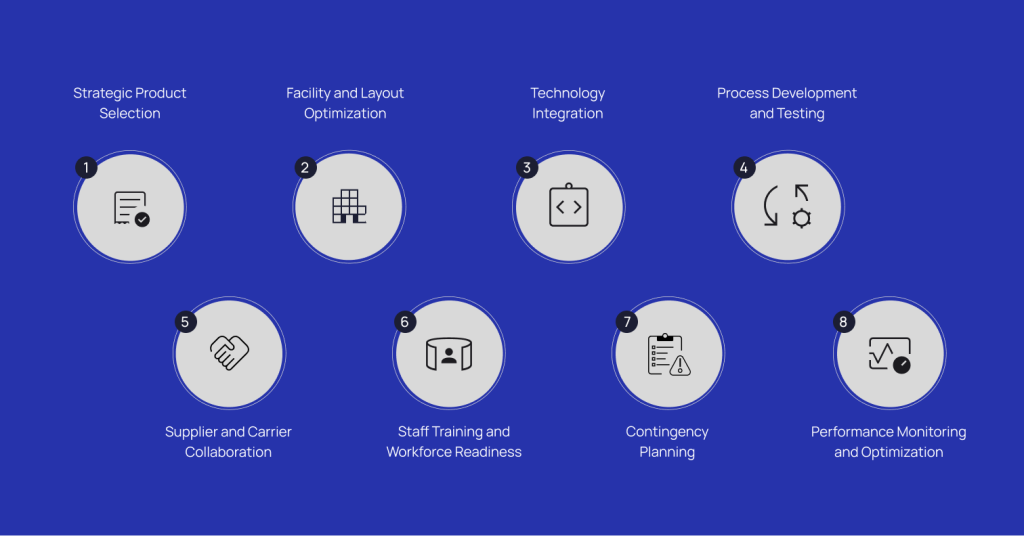
1. Strategic Product Selection
Begin by identifying products with consistent, high-volume demand and short shelf life like perishable goods, retail replenishments or promotional items. This is to ensure they move quickly through the cross-dock, minimizing storage and maximizing efficiency.
2. Facility and Layout Optimization
Set up a physical layout that separates inbound and outbound zones with minimal travel distance in between. A clean, one-directional flow improves speed and reduces labor movement. Allow space for temporary staging and invest in fast-access equipment like forklifts, conveyor systems, or pallet jacks.Designate dedicated dock doors for incoming and outgoing shipments, alongside a streamlined cross-docking area with efficient pathways to minimize handling and movement time.
3. Technology Integration
Invest in a modern WMS that connects with Transportation Management Systems (TMS) to sync inbound schedules and outbound truck assignments. Use tools like barcode scanners, RFID tags, and IoT sensors to track product movement without manual intervention. This reduces misroutes and improves visibility across the entire process.
4. Process Development and Testing
Develop detailed Standard Operating Procedures (SOPs) for unloading, sorting, staging, and loading and clearly define responsibilities for the staff. To prevent potential issues, run pilot tests to test workflows and resolve bottlenecks before scaling operations. Use these tests to identify load-balancing issues, equipment gaps, or WMS misconfigurations.
5. Supplier and Carrier Collaboration
Cross-docking requires precise timing. Make sure your suppliers commit to accurate delivery windows and your carriers can handle fixed dispatch slots. Misaligned shipments cause backups. Agree on labeling standards, packaging specs, and documentation formats upfront.
6. Staff Training and Workforce Readiness
Well-trained teams are essential for fast, accurate execution. Staff should know how to sort, scan, and load efficiently, especially when handling multiple product types or complex consolidation tasks. Offer regular training on new tech tools, safety, and updated workflows.
7. Contingency Planning
Have a backup plan for spikes in volume or late arrivals. Use buffer staging zones or secondary carriers as fallback options. Contingency protocols help you maintain service levels even when the schedules don’t align.
8. Performance Monitoring and Optimization
Continuously monitor KPIs and analyze data to identify areas for improvement. Use this data to fine-tune processes and cut waste. Over time, even small improvements in timing or resource allocation can make a major difference to your margins.
Common Mistakes to Avoid in Cross-Docking
Cross-docking can speed up your supply chain, but even small missteps can lead to delays, congestion, or missed deliveries. Here are some of the most common errors and how to avoid them.
- Lack of inbound visibility: Without accurate Advance Shipping Notices (ASNs) [3], unplanned arrivals can disrupt sorting, clog dock space, and delay outbound shipments. This usually happens due to poor supplier communication. Set clear ASN requirements, automate updates, and hold suppliers accountable for non-compliance.
- Overcomplicating workflows: Adding too many rules or steps slows down decisions and increases mistakes, especially during peak hours. Use your WMS to automate assignments, and streamline processes to only what’s necessary. Review procedures regularly to eliminate redundancies.
- No plan for exceptions: Damaged or mislabeled items can block the entire workflow if there’s no system in place. Set up separate lanes for exceptions and define quick-response SOPs to handle them without disrupting other shipments.
- Poor shipment tracking: Manual tracking or outdated systems increase the risk of lost items and delivery errors. Use GPS, sensors, and automated alerts to maintain real-time visibility and catch issues early.
- Documentation errors: Incorrect labels or missing paperwork often lead to misrouted goods or compliance issues. Automate documentation using barcode or RFID systems, and scan at each handoff to reduce human error.
- Dock layout or capacity issues: Misjudging dock space or traffic flow can cause bottlenecks and slowdowns. Use layout simulation tools to plan efficient zones for inbound, outbound, and staging areas.
- Relying on one carrier: Using a single transport provider can stall your dock if they face delays or equipment issues. Build a network of reliable carriers and create fallback plans to stay flexible.
- No surge planning: Ignoring seasonal peaks or sudden demand spikes puts pressure on docks and staff. Plan for volume surges with flexible staffing and hybrid cross-docking strategies to maintain flow.
- Skipping testing: Launching without simulations or pilots can expose major flaws mid-operation. Test your setup in small phases first to fine-tune processes before going live.
Fixing these gaps early can keep your cross-docking operations smooth, scalable, and ready for growth.
Industries That Benefit Most from Cross-Docking
Cross-docking works best in industries where speed, limited handling, and just-in-time delivery are critical to performance. By skipping long-term storage, these businesses reduce costs, move products faster, and stay competitive. Here are the sectors that benefit the most.
- Retail: Retailers such as supermarkets and department stores use cross-docking to keep shelves stocked with fresh goods, clothing, and other fast-moving items. It helps avoid stockouts and supports high turnover in both physical stores and omnichannel setups.
- E-commerce: Online businesses use cross-docking to process diverse orders quickly, especially during flash sales or peak demand. It enables fast fulfillment across suppliers without relying heavily on warehouse storage. Amazon and Privalia are examples.
- Automotive: Auto manufacturers depend on just-in-time delivery to keep assembly lines running smoothly. Cross-docking reduces the need to store parts, lowering costs and avoiding delays.
- Food and Beverage: This sector uses cross-docking to ship perishable goods like produce and dairy on the same day. It helps maintain freshness, reduces spoilage, and ensures compliance in temperature-controlled environments.
- Pharmaceuticals and Healthcare: Companies handling medicines, supplements, and lab supplies use cross-docking to move time-sensitive products efficiently. It helps avoid spoilage and supports regulated storage requirements. Roche Diagnostics is one example.
- Chemicals and Hazardous Materials: Cross-docking limits handling time for sensitive or dangerous goods, improving safety and reducing storage costs. It also supports direct and efficient routing.
- High-tech and Electronics: Electronics manufacturers use cross-docking to speed up the delivery of components for assembly. It supports faster product cycles and helps meet market demand for custom or fast-changing items.
- Cosmetics and Personal Care: Brands in this space use cross-docking to deliver products with shorter shelf lives quickly. Reduced handling helps preserve product quality and meet customer expectations.
Conclusion
Understanding how cross-docking works is a key step in modernizing your supply chain. By reducing storage time, speeding up deliveries, and lowering operating costs, cross-docking offers a clear alternative to traditional warehouse models.
To apply it effectively, you need to know the different types of cross-docking and how each one fits into your operations. The right setup can improve order accuracy, reduce inventory holding, and keep your logistics moving at pace.
Tools like Anchanto’s Control Tower add another layer of visibility and control. With real-time data, you can fine-tune your cross-docking process, respond faster to demand, and improve the overall customer experience.
Want help building a faster, more efficient supply chain? Talk to our experts to see how cross-docking can work for your business.
FAQs
1. What is the main purpose of cross-docking?
Cross-docking moves goods directly from incoming to outgoing transport with little or no storage. This reduces handling time and speeds up delivery. It works best when inbound and outbound schedules are tightly aligned and shipments are frequent and predictable.
2. How is cross-docking different from dropshipping?
Cross-docking uses a facility to sort and transfer goods between trucks. It supports order consolidation and faster distribution. Dropshipping skips the middle step. Suppliers ship directly to customers, with no inventory held by the seller. Choose cross-docking for bulk flow, and dropshipping for low-touch e-commerce.
3. Which industries use cross-docking?
Retail, e-commerce, automotive, food and beverage, pharmaceuticals, chemicals, electronics, and cosmetics all benefit from cross-docking. It’s ideal for industries needing fast movement, minimal storage, or just-in-time delivery. Partner with logistics providers who understand your sector.
4. Does cross-docking reduce inventory costs?
Yes. It lowers costs by reducing storage time and freeing up capital tied in stock. With accurate forecasting, you can avoid over-ordering and measure cost savings in warehousing and inventory turnover rates.
5. What infrastructure is needed for cross-docking?
You’ll need a facility with multiple docks, sorting zones, and equipment like conveyor belts. WMS and TMS software help manage flow and track movement in real time. Sites near highways or ports are ideal for faster turnaround and reduced transit times.
References:
[1] Mckinsey.com – Retail’s need for speed: Unlocking value in omnichannel delivery
[2] Inc.com – Steal This Idea: How Walmart Uses Cross-Docking to Save Billions of Dollars a Year