
From Manual Intensity to Automated Precision: How TASCO Enabled Faster Fulfillment and Growth
Case Studies
Key Highlights:
- TASCO’s vision is to be Malaysia’s default logistics partner for brands and businesses with large-scale e-commerce and supply chain operations.
- They set out to strengthen their role as a leading logistics backbone in the country, aiming to offer high speed, accuracy, and long-term scalability.
- But manual warehouse processes, limited operational visibility, and slow marketplace integrations caused friction as order volumes, SKUs, and customer expectations grew.
- To resolve their challenges, they implemented Anchanto’s SaaS technology to automate core warehouse workflows, connect marketplaces into one operational environment, and gain real-time visibility across operations.
- The result: TASCO now delivers the speed, accuracy, visibility, and scalability needed to support top-tier brands, strengthening its position as Malaysia’s preferred logistics partner.
Introduction
For more than five decades, TASCO Berhad has operated with a clear ambition: to connect people, businesses, and communities to a better future through logistics. As part of Yusen Logistics Co. Ltd. and the global network of Nippon Yusen Kabushiki Kaisha, TASCO plays a strategic role in powering supply chains across Malaysia and beyond.
But becoming the world’s preferred supply chain logistics company requires more than physical infrastructure. It demands digital architecture that delivers real-time visibility, engineered accuracy, and scalable speed across every operation.
As e-commerce complexity increased and volumes accelerated, leadership recognized that manual intensity could not support long-term ambition. Anchanto’s Order and Warehouse Management platforms provided the operational backbone TASCO needed, aligning directly with its mission to drive insight, service quality, and innovation to be the top logistics provider in Malaysia.
The following sections outline the operational challenges TASCO faced and the strategic solutions implemented to ensure its long-term vision continued uninterrupted.
Requirements
As e-commerce volumes increased and customer expectations tightened, TASCO recognized that operational precision would determine its ability to scale sustainably. Manual processes and fragmented workflows were beginning to limit speed, visibility, and cost control across warehouse operations.
TASCO faced several operational challenges that required structural attention:
- Manual Warehouse Dependency: Heavy reliance on manual processes across inbound, picking, packing, and shipping operations resulted in slower processing time and a higher risk of human error.
- Limited Operational Visibility: A lack of real-time insight into inventory movement and order status reduced leadership’s ability to make fast, data-backed decisions.
- Rising Fulfillment Risk: Increasing SKU counts and order volumes created greater exposure to mis-picks, shipment errors, and customer dissatisfaction.
- Slow Marketplace Onboarding: Time-intensive integrations delayed go-live timelines for new sales channels, limiting speed to market.
- SKU Management Complexity: Managing multiple brands and high SKU volumes within disconnected workflows added coordination strain and reduced efficiency.
- High SLA Pressure: Growing customer expectations around delivery timelines increased operational stress and risk of service-level penalties.
- Cost and Speed Balance: Efforts to increase speed and accuracy often required additional manpower, placing pressure on cost efficiency.
- Limited Value-Added Focus: Teams were absorbed in repetitive operational tasks, reducing their ability to focus on strategic, value-added services for customers.
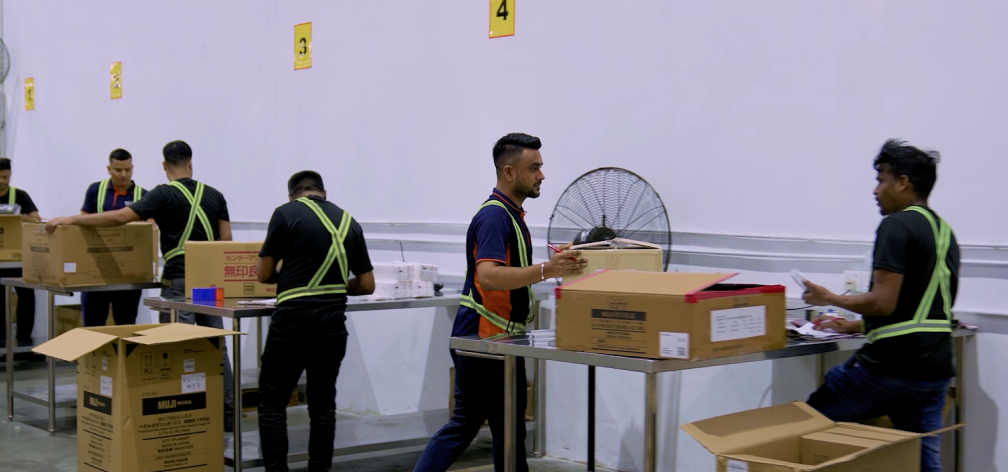
Implementation
To address the operational constraints identified, TASCO decided on a strategic transformation. The objective was not simply to introduce a new system, but to eliminate manual dependency, strengthen visibility, and build a warehouse environment capable of sustaining higher volumes without compromising accuracy or cost control.
Anchanto’s Order and Warehouse Management platforms were implemented with a clear focus:
- Replace manual execution with barcode-driven automation
- Integrate multiple marketplaces into one unified environment
- Enable real-time reporting for leadership visibility
- Support growth without increasing operational complexity
The migration was structured and carefully managed, ensuring operational stability as teams transitioned from legacy processes to automated workflows. Early challenges were addressed proactively, with Anchanto’s account management and technical teams providing hands-on, on-ground support to resolve issues quickly and minimize disruption.
Solutions
With the new operational backbone in place, TASCO began addressing the structural challenges and requirements holding them back. What followed was not an incremental improvement but a measurable shift in how the warehouse and e-commerce operations functioned day to day.
1. Warehouse Automation
The defining shift for TASCO was automation inside their warehouse. Barcode scanning, pick-and-pack workflows, and shipping automation replaced manual documentation and verification steps. Teams could now track inbound and outbound movement with precision.
The impact was immediate. Tasks that previously required significant manual effort became standardized and system-driven. Processing 100 orders now takes a few hours instead of an entire day.
Accuracy also improved, fulfillment became more reliable, and operational errors declined. Most importantly, warehouse teams could shift their focus toward value-added services rather than repetitive manual tasks.
2. Seamless Marketplace Integration and Expansion
E-commerce logistics requires constant connectivity. With Anchanto, TASCO integrated multiple marketplaces into a single software. Onboarding a new marketplace no longer required weeks of configuration. It could be completed within hours.
This capability enabled TASCO to manage more brands, handle higher SKU volumes, process greater daily order volumes, and meet high-SLA commitments confidently. Instead of being constrained by system limitations, TASCO could pursue growth opportunities with speed.
3. Real-Time Visibility Across Operations
Leadership emphasized one critical requirement, which is visibility. The SaaS solution from Anchanto provided real-time access to operational data, inventory movement, inbound and outbound status, and performance reporting.
Reports that were once difficult to generate became instantly accessible. This enhanced visibility strengthened decision-making, improved internal coordination, and reinforced customer confidence through greater transparency.
4. Flexibility and Partnership
Beyond functionality, flexibility mattered a lot to TASCO. The WMS and OMS systems were customized to fit TASCO’s operational structure rather than forcing rigid process changes. The account management and technical teams at Anchanto supported migration, resolved early challenges quickly, and ensured a smooth transition.
For TASCO, this was not a vendor relationship. It was a partnership built around shared growth.
Outcomes
With automation and integration in place, TASCO achieved measurable operational gains:
- Higher order processing, fulfillment, and inventory accuracy
- Real-time visibility across warehouse operations
- New marketplace integration within hours
- Increased SKU and brand management capacity
- Improved SLA performance under high order volumes
- Greater team productivity and cost efficiency
Technology became the operational backbone TASCO needed to support modern e-commerce logistics.
If you operate high-volume warehouses, manage multi-marketplace e-commerce fulfillment, or aim to scale without increasing operational overhead, manual processes eventually become your biggest constraint. This is exactly where TASCO saw the need to rethink its operational foundation.
What This Means for Large-Scale Logistics Providers
If you operate high-volume warehouses, manage multi-marketplace e-commerce fulfillment, or aim to scale without increasing operational overhead, manual processes eventually become your biggest constraint. This is exactly where TASCO saw the need to rethink its operational foundation.
By implementing Anchanto’s OMS and WMS, TASCO moved toward a more connected and scalable model. A unified system like Anchanto enables:
- Automation across inbound and outbound operations
- Real-time performance visibility across warehouses and marketplaces
- Faster marketplace onboarding with standardized integrations
- Higher accuracy at scale through system-driven workflows
- Cost control through process standardization and reduced manual dependency
In logistics, choosing the right technology is not an enhancement. It is a vital infrastructure. As TASCO’s journey shows, Anchanto’s platform becomes the operational backbone that allows logistics providers to scale without friction, ensuring that growth drives momentum rather than operational strain.
Conclusion
For TASCO, this transformation marked a structural evolution. Manual intensity gave way to automated precision. Warehouse execution became data-driven. And, marketplace expansion became frictionless.
With a scalable and flexible operational backbone in place, TASCO is positioned to expand its footprint across key regions in Malaysia over the next four to five years.
Anchanto is not simply a system provider. It is an integral partner supporting TASCO’s next chapter of business growth.
About TASCO
TASCO was incorporated on 10 September 1974 and listed on the Main Market of Bursa Malaysia Securities Berhad on 28 December 2007. A subsidiary of Yusen Logistics Co. Ltd., TASCO operates 24 logistics centers across Malaysia with more than 2,200 employees.
As part of Yusen Logistics’ global network of 594 locations worldwide, TASCO provides comprehensive logistics solutions across air, sea, and land transportation, serving both domestic and international customers as a one-stop logistics center.